

Unless health IT teams become more proactive, a wide range of legal, clinical and financial consequences resulting from poor legacy data management will escalate.
Unless health IT teams become more proactive, a wide range of legal, clinical and financial consequences resulting from poor legacy data management will escalate.

A conversation with Art Papier, MD, CEO and co-founder of VisualDX.

Joseph Cacchione, MD, FACC, executive vice president of Clinical & Network Services at Ascension, discusses how his company was able to provide care and support to patients and staff during the pandemic.
Ascension's use of a multi-channel approach to get COVID-19 vaccines to their communities was beneficial in improving access, said Joseph Cacchione, MD, FACC, executive vice president of Clinical & Network Services at Ascension.
Justin Williams, CEO of Noteworth, discusses how predictive analytic tools can improve the quality of care for patients with chronic diseases, discharged hospital patients, and patients from rural communities.
Joseph Cacchione, MD, FACC, executive vice president of Clinical & Network Services at Ascension, explained the advantages of working in a multi-state system during a pandemic and how Ascension catered its response to better serve diverse populations.

Joseph Cacchione, MD, FACC, executive vice president of Clinical & Network Services at Ascension, described some of the lessons he learned from operating in states that were hit hard during the early days of the COVID-19 pandemic.
Joseph Cacchione, MD, FACC, executive vice president of Clinical & Network Services at Ascension, discusses how collecting data on social determinants on health and food insecurity helped address health equity during the pandemic.

It is crucial to target the users of transfusions—surgeons and hospitals—with tools that can be used to change practice and limit transfusion to patients who actually need it.
Humana's 2021 Bold Goal Report, released last week, highlights the importance of health system partnerships.

The award is named for Seema S. Sonnad, PhD, who helped launch and then co-directed the Value Institute at ChristianaCare in Delaware, one of the nation’s largest, integrated healthcare systems.

After months of tribulation, Methodist Health System found a solution to our COVID-19 testing challenge in high-throughput (HTP) antigen tests, which could be run on analyzers already installed in our hospital labs.

Survey findings show some health systems have fallen short in meeting cardiologists’ basic needs, with 41% saying they might cut back hours, change jobs or retire due to lack of health system support.
Carol McCall, from ClosedLoop.ai., discusses what’s holding back healthcare administrators from taking advantage of what artificial intelligence (AI) platforms have to offer and what the future holds for AI and machine learning in healthcare.
COVID-19 has shifted the bargaining power for healthcare providers in the real estate market.
Given the rise in healthcare data leaks from cloud services, healthcare leaders must ramp up their security efforts tenfold.

Chief Healthcare Executive™ discusses the CEO Coalition's new Declaration of Principles aimed at improving healthcare worker safety with Coalition co-founder and Declaration co-author Johnese Spisso, MPA.

For healthcare to come home—and for it to remain there—a different kind of infrastructure must be built.
Waqaas Al-Siddiq, founder and CEO of Biotricity, discusses how the Biden-era American Rescue Plan is impacting telehealth and remote patient monitoring and how these technologies will fit into a post-COVID-19 society.

A study identifies factors that put patients with COVID-19 receiving home-based care at risk for care escalation.

Before the pandemic, the healthcare sector was a prime target for cybercriminals. But the rise of remote work has only increased vulnerability
According to Pew Research, 96% of Americans own a cell phone and 81% have a smartphone, which are the devices they use to communicate and access information on a daily basis.
Sentara Healthcare announces the formation of its Supplier Diversity Executive Council.

The company hit the restart button in 2012 when it saw an opportunity to address the affordability gap in healthcare, as costs began started to shift from the payer to the consumer.
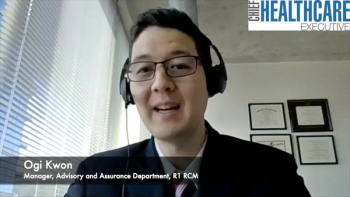
Ogi Kwon, of R1 Revenue Cycle Management (RCM) offers insights on lessons learned from the COVID-19 pandemic and the future of price transparency.
Moving healthcare home is just part of the growing personalization of healthcare that has been made possible by advancements in technologies that seamlessly connect a patient to their care team.

Americans want their providers to use electronic methods to prescribe medications, according to new survey findings.