Sponsored Content

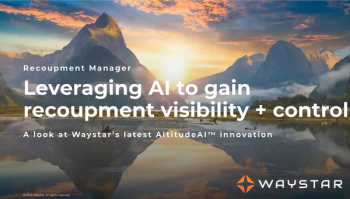
Calling recoupments a “billion-dollar” problem is a bit misleading. Each year, more than $40 billion in provider revenue is silently recouped by payers. The good news: AI is the ideal tool to transform recoupment workflows — and it’s already delivering an 80% time savings as teams work each PLB adjustment in under 1 minute. Watch this webinar for the first public look at Waystar Recoupment Manager, a new, AI-powered solution designed to autonomously identify, validate, and match recoupments. Hear from Trish McMillion, US Renal’s leading expert on recoupments, about key capabilities and insights her team has uncovered as Waystar early adopters.

Most Canadian healthcare organizations still run on paper packets, disconnected PDFs, and fax. The result: cancelled surgeries from missing consents, failed audits from absent timestamps, and patients who leave over a poor digital experience. This executive guide shows how one HITRUST-certified, PHIPA-aligned platform unifies every form workflow across MEDITECH, Epic, and Oracle Health, turning fragmented paperwork into connected, audit-ready data.

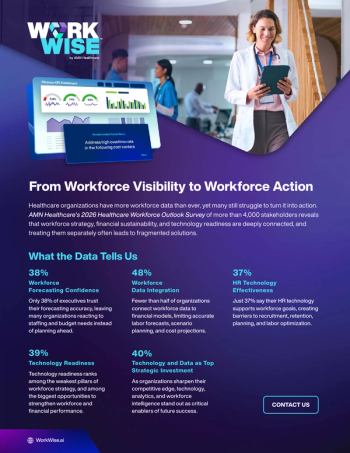
Healthcare organizations are navigating some of the most significant workforce challenges in recent history. AMN Healthcare's 2026 Healthcare Workforce Outlook Survey captures insights from 4,040 healthcare professionals across nine workforce segments, providing a comprehensive view of workforce engagement, staffing confidence, leadership effectiveness, and future readiness. The research reveals where healthcare organizations are finding opportunities to strengthen retention, support employees, and prepare for future workforce demands. Download the report to benchmark your organization against national workforce trends and uncover data-driven strategies to build a more resilient, engaged, and prepared workforce.

Automation is reshaping patient access and financial clearance. But when tools are disconnected, they can create fragmented workflows, delayed decisions and added staff burden.Our new e-book explores five shifts that can help health systems move beyond point solutions and build a more connected pre-care automation strategy. You’ll learn how real-time insight, strategic workflows and human expertise can help simplify access, reduce rework and support stronger financial performance.

Healthcare organizations have more workforce data than ever, yet many struggle to turn it into meaningful action. Based on findings from AMN Healthcare's 2026 Healthcare Workforce Outlook Survey of more than 4,000 healthcare stakeholders, this report explores the connection between workforce strategy, financial sustainability, and technology readiness. Discover key insights related to workforce forecasting, data integration, HR technology effectiveness, and workforce intelligence, and learn why healthcare leaders are making technology and analytics a top strategic priority.

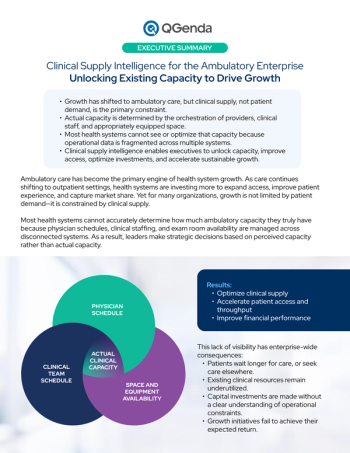
Ambulatory care has become the primary engine of health system growth. As care continues shifting to outpatient settings, health systems are investing more to expand access, improve patient experience, and capture market share. Yet for many organizations, growth is not limited by patient demand—it is constrained by clinical supply. By unifying physician, clinical team, and space data into a single source of truth, QGenda gives executives real-time visibility into the resources that determine actual capacity. Leaders can identify operational bottlenecks, improve patient access, optimize existing assets, and make more informed workforce and capital investment decisions.

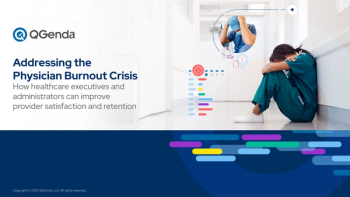
Learn what’s driving the physician burnout crisis and what healthcare leaders can do about it. This eBook explores the key causes of burnout, including staffing shortages, administrative burden, and lack of schedule flexibility, and outlines practical strategies to improve physician satisfaction, retention, and work-life balance. Discover how smarter provider scheduling can help reduce burnout and support a better experience for both clinicians and patients.

Healthcare organizations are under growing pressure to improve financial performance while navigating rising labor costs, constrained resources, and increasingly unpredictable margins.

Healthcare reimbursement is seemingly always in flux. Policy shifts, payment recalibration, and rising operational pressure constantly reshape how — and how much — organizations get paid. That makes staying ahead of reimbursement trends in healthcare essential.

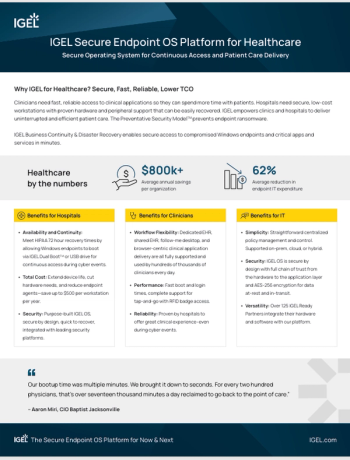
IGEL provides a secure endpoint OS optimized for SaaS, DaaS, VDI, and secure browser environments. It reduces endpoint TCO and attack surfaces while preventing ransomware and cyber threats.

Patient expectations for healthcare access continue to evolve. From finding the right provider and scheduling appointments to understanding insurance coverage and completing pre-visit tasks, consumers increasingly prioritize convenience, transparency, and seamless digital experiences. To better understand these preferences, Optum surveyed more than 1,000 healthcare consumers about their experiences, frustrations, and expectations when accessing care.