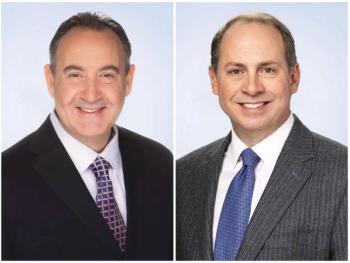
Dr. Jonathan Perlin, the commission’s CEO, and Dr. James Merlino, his successor, see enormous potential in improving patient safety.
Dr. James Merlino, who takes over as CEO next year, talks about working in partnership to help hospitals improve.
For 75 years, The Joint Commission has served as an accreditation body examining hospitals, upholding safety standards and pointing out where health systems need to do better.
The commission’s work carries weight. Hospitals who have been accredited by The Joint Commission can participate in Medicare and Medicaid programs, which provide essential funding for virtually all U.S. hospitals.
In the past few years, the commission has sought to refine its mission. Dr. James Merlino, who will succeed Dr. Jonathan Perlin as president and CEO of The Joint Commission in January, says the organization’s role is meant to support hospitals and help them improve. The commission said last week that
In a joint interview with Chief Healthcare Executive® last week, Merlino said that when he takes over, he will work to partner with health systems to help them get better, and he credits Perlin with helping the commission make that fundamental shift.
“We finally see the Joint Commission as a partner in safety and quality, as opposed to just an accreditor,” Merlino says. “That was a proud moment because that was part of the lead of the transformation is to get us relevant again, get us back to our mission.”
“This is an organization that is built on relationships, and many of the relationships that have been recently rebuilt are critical not only to our success, but our future,” Merlino says.
The commission’s fundamental mission is to improve quality and safety, Merlino says.
And he says that has been true since its founding. The commission has also worked with hospitals outside the U.S.
A nonprofit organization, the commission has seen its role evolve in recent years as the accreditor and, as Merlino says, akin to being seen as the “policeman” for the Centers for Medicare & Medicaid Services.
“We have an absolute responsibility to CMS in the domestic market to make sure that we're going in, we're surveying hospitals, and we're ensuring that hospitals are meeting the conditions of participation,” Merlino says. “That's our requirement. And we should do that, and hospitals are better when we do that.
“But we have an additional responsibility, and that is to help improve and be a partner improving safety and quality,” he adds.
Merlino points to a program launched under Perlin to help promote best practices.
“Our job of our team is to harvest those best practices, write them up so that people can use them, and then distribute them,” Merlino says. “And that's just one thing we're doing to be a better partner to help drive safety and quality improvement.”
In the joint interview, Perlin also highlights the commission’s greater focus in working with hospitals.
“We actually revised our mission statement, so, as Jim said, we could move from a role of just being a compliance check to being a partner for elevating care,” Perlin says.
“We know that we aren't at the front lines giving care, but as Jim said, we have the great privilege of seeing those practices that work best not only in the United States, but around the world,” he adds.
In January, The Joint Commission launched the “
Perlin says that’s an important factor in helping hospitals improve. In the past, the commission has focused on deficiencies in health systems, but the organization is now working to help share solutions to improve safety.
“When you look at the evolution of patient safety over the last three decades, you know, we've made progress,” Perlin says. “But there's a fair question: Why haven't we made more progress?”
He points out that addressing safety in hospitals isn’t the same as fixing a part on a 737 jet.
“In health care, the emergency room in rural Oklahoma is very different from the emergency room in a quaternary health center in Manhattan,” Perlin says. “And a solution that works in one place may not work in the other.”
Perlin says it’s important to identify the failures, but also outline the success, in order to drive quality improvements in health systems.
Both Merlino and Perlin say they see The Joint Commission gaining even more relevance for hospitals and health systems during a time of such rapid change in healthcare.
“I think it's fair to say there's never been a more brutally complex moment in healthcare than the current time,” Perlin says. “That's true domestically and internationally.”
“And I think the work that Jim will do is so critically important because we can accelerate learning. We can accelerate addressing the significant challenges: quality, safety, affordability, accessibility, use of information if we learn collectively. And I think one of the secret sauces of the Joint Commission is that we can tap into the collective memory of healthcare around the world.”
Merlino brings plenty of experience working with hospitals. Before becoming COO of the commission, Merlino held leadership roles at The Cleveland Clinic, including serving as the system’s chief clinical transformation officer.
He says one of his main goals will be helping health systems deal with workforce challenges.
“There's no question that there are tough headwinds,” he says. “I'm a pragmatist. We've been on the other side, we know what that looks like, and they are real.”
But he also says he’s optimistic about the future.
“When you think about the opportunities in front of us, the opportunities with technology, with AI and what that can bring to the industry, scientific discovery, you know, we should be personally optimistic for that,” Merlino says.
He also points to the commission’s nonprofit status as a reason health systems can have confidence in their recommendations.
“Organizations know that when we bring information, it's important, they should listen, and they trust us,” Merlino says. “And so, our opportunity is to lever that reputation, to lever those relationships, to bring information in a non-burdensome way to help organizations with what they're doing every single day to take care of people.”