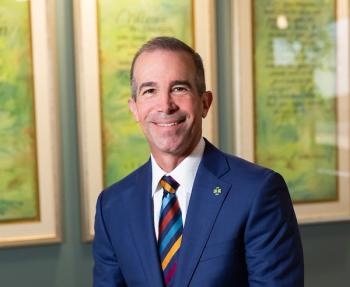
In an interview at the Becker’s CEO + CFO Roundtable, Wexler talked with us about the system’s progress, making tough calls and looming challenges.
The head of Northwell Health’s business arm talked with us about commercialization, helping the health system and what founders should know.
Northwell Holdings is seeking innovative companies that can solve important problems in healthcare.
Richard Mulry, president and CEO of Northwell Holdings, talked about his approach in a conversation with Chief Healthcare Executive® during an interview in Chicago earlier this month. Mulry was in the Windy City for the Becker's CEO + CFO Roundtable.
Northwell Holdings is the business and commercial arm of Northwell Health, aiming to invest in cutting-edge companies.
“The first really big question we ask is: Is this solving for a problem that we have? Many companies built brilliant solutions, but it wasn't fixing a problem, and it was built outside of a healthcare system,” Mulry says.
“We think working and partnering with us early organically brings those ideas from the front line, helps us develop or co-develop the solution,” he adds.
Mulry says Northwell Holdings is also seeking startups with solutions that are “differentiated.”
As he says, “Why is this a better solution than the others, and is it protectable? Can someone come in behind you and just duplicate this, or is there a moat around it?”
Northwell Holdings aims to launch companies with novel solutions, while also helping provide a financial boost to Northwell Health, which operates 28 hospitals and more than 1,000 care locations in New York and Connecticut.
This is one of a series of interviews with leaders at the Becker’s conference. Look for more in the coming days.
Here is the transcript of our conversation with Richard Mulry.
Q: Northwell Health launched Northwell Holdings, its business arm, more than a decade ago. Can you talk about the work you're doing to bring new ideas to market?
Mulry: “So Northwell Holdings is a byproduct of what we called Northwell Ventures. About nine years ago, the system wanted to take a try at venture investing, but also as a way to really introduce innovation into the health system. It was also a way to financially explore a way to bring returns back as well.
“We thought the combination of being able to leverage the health system and put money into a company and really partner with them was going to be accretive in value to the company, but also help transform Northwell internally too through that collaboration. So over the course of the last nine years, that's evolved into Northwell Holdings. Since that time, we continue to have minority equity investment, but we're also driving value back to the health system through partnerships as well as company creation.
Q: How does Northwell Holdings help support the finances of the health system?
Mulry: “So Holdings helps support Northwell's finances in a number of ways. The solutions that we pick, though they align with a thesis, are really meant to help improve the way we deliver care, patients experience care, our coworkers can deliver care, and efficiencies within the system. So we believe it has bounded, measurable ROI and an ability for us to improve the metrics that we hold ourselves accountable for to deliver care.
“So just the very fact that we have a partnership or an investment in a company is very helpful to the system. In, I'd say, longer term, but it's becoming shorter term, we want a return on invested capital. That comes through working with the company and trying to optimize its value through our partnership. So by demonstrating the proof of concept, does this work, and then trying to bring it to enterprise scale, and we help inform the company on its go-to-market strategy. So the true partnership really does help the company just as much as it helps us internally with Northwell.”
Q: Northwell Holdings and Aegis launched Ascertain a few years ago. Can you talk about Ascertain and some of the gains you're seeing in streamlining prior authorization?
Mulry: “So Northwell Holdings was a minority equity investor for a number of years, but we still saw gaps in the market. So there were no market solutions for some of the things that were pressing problems. Aegis Ventures was a company creation studio that was early in its launch, based in New York City. We realized a while ago that we have tremendous resource and expertise within the health system. Creating and running a company is a different skill set, probably not where we wanted to leverage most of our skills and resources on that side of the equation. So it was a perfect partnership to bring the studio to work with us.
“So when we initially worked with them, they met with over 50 business and clinical units across the enterprise. It was a very intense process where we were asked to reimagine what we do. At that time, generative AI wasn't really part of the daily conversation. It was just on the advent of that, and we were able to reimagine your workflow. So now we say if it was native AI and it's a whole new workflow, or because we just didn't want to automate a bad workflow or a workflow that was always dependent on legacy systems, we picked an area that was going to allow us to automate pre-authorization, and we picked transitions of care. It seemed to be the place where we had the most variation at the time.
“There were a lot of different steps, a lot of different systems, and we really weren't doing it, we thought, in an optimal way. So, working with our senior leadership, that was the first use case. We formed a company called Ascertain, and it was really built with that objective in mind, to bring AI agents to automate workflow.
“We hired an external team, and this is where the partnership with Aegis becomes incredibly valuable. So, helping recruit the talent. Health systems sometimes can have a hubris that we're very good at running our health systems, so we can run that company. It's a bit of a different skill set. I think these companies are afforded an opportunity that's tremendous by partnering with the health system, but operating as their own independent entities in the market.
“Having a management team that is investable by the market really leads to better long-term success for what we're building and what we want to take to scale, and so we launched that a number of years ago. It followed our Epic implementation and our transition to Google Cloud. So the company learned a tremendous amount along the way about working with a very large-scale health system.
“Where are we today? We have a wonderfully automated process. It's taken a number of different systems and integrated them. Lots of steps had to be done manually, or also interpreted by individuals in terms of what the rules were. So the system ingests standardized rule sets, works directly with the payers, has chase functions to collect all the information, and the end users really can focus. The case managers really have to spend less time chasing down administrative information, and more time focusing with the families on what's the best possible place to transition the care for that loved one. And so it's really something that we're very proud of, and in terms of its scale.
“So the company is proceeding through its fundraising rounds. Other health systems see it as valuable. It's starting to scale, so it's really proving out the concept. It was one of the earlier ones, and we're very, very excited about the prospects for the future.
Q: Can you please talk a little bit about MD On Board, the remote medical advisory service company, and UPMC's recent move to become an investor of MD On Board?
Richard Mulry: “MD On Board is a really exciting company. It really stemmed from Northwell used to provide coverage to some of the airports for emergency medical services. They realized there was a mismatch, and sometimes what they were called for in order to transport a patient from a flight that might have been diverted or there was a medical emergency was often not the same.
“We did a little bit more research in the area and found it's a terribly manual process. It relies on writing things down and handing them off to the cockpit that radios down and talks to a dispatcher and connects with a third party. So lots of room for variation, misinterpretation. We thought we have an incredibly powerful emergency on-demand system within the health system to deliver services within our community. We could harness that and take that and bring it to the market, and we did. And so, MD On Board was initially launched with in-flight medical emergency for commercial and business aviation clients.
“Since then, it's expanded because we do a number of services that are pre-flight. So, if you're fit to fly, gate screening, as well now as the in-flight crew health when crew is deployed through partnership. There's an ability to have crisis management services. We help the airlines with their training, and we're developing right now medical kits that are going to go into production to help in the event of an emergency.
“So, UPMC had a similar service line, and we've worked with UPMC for years on a number of different co-investments and opportunities. And it's a wonderful community of like-minded health systems that have been able to work together. Interestingly, Aegis formed a digital consortium. UPMC and Northwell were two of the founding members of that. So, really, through that partnership, we started to have just an exchange of ideas.
“UPMC folded their business unit effectively in, which was wonderful because we formed a purpose-built proprietary tech platform that has audio and visual integrated, so the flight crew can actually pull up the application and have a paramedic and an emergency room physician trained in aviation medicine on the line very quickly. So no more writing it down and passing the word on. So they have immediate access, which has tremendous benefit. UPMC saw the value in that, and what was wonderful is they've been delivering like services for almost three decades.
“So by combining the two, we have now 30 years of their experience combined with what we think is the most tech-forward platform, and the ability to power this through a health system. Now it has the power of two systems behind it, and UPMC had conviction in the company and the idea so much that they also made an additional capital investment in the company. So we're thrilled to have their partnership. We're thrilled to have the input that two large health systems can bring. So this isn't a tech company that's trying to hire medical services to help a service. This is healthcare organizations really harnessing the power of what they do best and bringing that solution directly to the market where there was a really strong need.
Q: Talk about the companies you choose to invest in. What are the qualities that you're looking for?
Mulry: “So there's many more companies that we want to invest in than we actually end up being able to invest in, and so the process is fairly rigorous for us to be able to determine what's going to be the best fit for us. So right now, there's many competing uses for capital.
“The first really big question we ask is: Is this solving for a problem that we have? Many companies built brilliant solutions, but it wasn't fixing a problem, and it was built outside of a healthcare system. We think working and partnering with us early organically brings those ideas from the front line, helps us develop or co-develop the solution, so it's immediately addressing that kind of a problem, and more and more those solutions have to have immediate return on investment in some way, shape, or form. They're kind of drifting more towards the core services of the health system, is that, more than they have in the past, just because capital is relatively limited.
“The other big shift that's happened: So we usually went in in seed or Series A, which is early stage. We're doing Series A, Series B now a little bit more. Part of that is related to risk profile, time to market, but also there's a significant resource consumption that comes with shepherding a company through. So we're trying to be sensitive to what the organization's already trying to achieve as part of its daily operations, and bring this innovation and this investment in in a way that's complementary and doesn't overtax the system.
“So when we look at it through that lens, the other quality really is the management team. We've seen the best solutions not make it to market because the management team didn't look at it as a true partnership. So we're not just saying we're sitting on your board and we're giving you capital. We're saying we can help shape the way that this product is brought to market so it's most effective, most valued by a health system. If it's valued by us in these ways, it's probably valued 80 to 90 percent by almost every single healthcare system.
“So, all of the learnings, if they're challenging or not, are really brought to bear and are reflected in the final product of the solution when we finally get it to implementation for us. So we look for partnership above and beyond all of the others, and the rest follows a typical venture capital diligence process that has fairly good rigor. But yeah, I think the unmet solution.
“The other is it really has to be differentiated. Why is this a better solution than the others, and is it protectable? Can someone come in behind you and just duplicate this, or is there a moat around it? And like I said, more important than anything is that management team that are going to be your partners over several years as you bring the company to market.
Q: How do you view your risk tolerance as you examine these companies?
Mulry: “So early-stage investing is always going to have a measure of risk, and so the question we ask is, what level of risk are we comfortable with? When we do our diligence, we really are trying to make sure that this is a product or solution that we need. More and more, we have been looking.
“The technology has shifted over the past few years, so there's a lot more platform solutions, less point solutions. We're not going to invest in companies that are going to compete with ourselves or the tech debt we've already incurred to have those platforms brought live, so something that's complementary or completely differentiated, and in that way it has a higher level of achieving success because it won't have internal friction within the organization.
“The other is really, I think, as I said earlier, working with that management team, which is going to be key. But the third element is really talking to other health systems. How do we de-risk or mitigate risk for that investment? Proving that it works, and then making sure that we tell others that it does. And we try to encourage the community of venture capitalists that we work with, as well as other health systems, and start to have those conversations early in our process and keep them in the loop, and it's almost natural, it's organic, that those other health systems can either make an investment in the company or buy the product commercially.
“Either way, it's just helping the company achieve targets, their revenue targets, also their client base, and the more impactful that it can be across the healthcare spectrum, the better for the company.”
Q: To elaborate on that, what advice would you have for startups looking for investments? What should they be focusing on, and what mistakes should they avoid?
Mulry: “So, you know, because we're investing in companies and have started companies, we have tremendous empathy for the founders of these startups. It's very hard to make a connection inside the health system. So we say, when you finally get to us, and you want to make best use of the time, make sure, with some of the other qualities that I mentioned, that you have already validated the fact that this is a real pain point for a system. It can drive value, and it's measurable and bounded.
“So you're going to be able to prove iteratively each step of the way that the product is working or achieving the goals for the organization, that it's cost effective. And we can talk about that maybe in the context of AI. But that is more and more becoming a concern, about how much these solutions cost. It used to be a linear curve on SaaS models, and now when we're talking about other kinds of frameworks, that can get very expensive. So we want to make sure that they understand the price point at which health systems can buy, if there are enterprise caps that need to be put into place, because you can't have a linear cost in terms of your budget as you expand solutions. It just doesn't work for a health system. So we need to be creative in the pricing model.
“And then the other is really approach it with: We appreciate the fact that you are creative, innovative. You've created a novel solution, so you're there already because you're thought of very highly, just in terms of your creativity and your intellectual ability. How well are you going to be able to be a partner to us? So, are you going to be able to take the feedback that we give you, modify the product, and really make it work, and allow us to make it work with you, and then spread the word? And so those are the types of things that we really do look for.
“So if a new partner is coming to us, we just tell them to be mindful, to be proud of what they've done, but approach it with a good mix of humility and openness about the process. That's going to represent a really good partnership. Like I said, it takes three to five years. That goes by quickly, but every day when you're working on a product, it can go by very slowly, so that's really critical, that both teams get along.”
Q: Is it safe to say that Northwell Holdings will be investing more in AI and agentic AI?
Mulry: “So investments in agentic AI: I wouldn't say we'll be making them in agentic AI for its own sake, but we do see nearly every solution that's coming to market now have some form of agentic framework that's helping improve the delivery of the product. So, the answer in the bigger picture is yes.
“The question then is going to be, as this continues to evolve, and it's a daily discussion. You know, we see tremendous promise, and then we see tremendous fear and risk. And so, how are we within healthcare trying to balance that out with what we see in front of us in terms of solutions? And there's a lot of competition. So our core platforms offer lots of agentic solutions.
“We have what we call an AI hub, where we're able to build our own agents. We've created companies, Ascertain, for example, that has an agentic framework that executes on work, and then we're investing in a number of companies that also do the same. And so, there's a lot of different places that these solutions are going to come into the organization.
“So our big question, from top down and bottom up, is going to be governance. There's a bifurcation, really, of clinical application and business. For the business component, business flow automation, we're just making sure that the processes are working and they're achieving the needs. On that end, though, all of these become budget expense lines very quickly. So how's the model built? How is it incurring expense as it's used? And we're very mindful of how that ends up being both a cost to us as well as having an ROI.
“And clinical, we say speed moves at the rate of trust, and really trust isn't in this big endpoint. We do pilots, but it's really in the small proof points. It's iteratively: You say what you're going to do, and it does it, and then we continue to build from there, keeping humans in the loop. So the patient's always in the loop as a human. Where are our clinicians in this process?
“And we look at it right now as not replacing any effort, really just facilitating the process and summarizing information, making it easier for our caregivers to look at information and make medical decisions or better research them. So, all of those solutions are going to end up in that we're putting more money into them, either as a capital investor or a purchaser services.”
Q: What are you most excited about looking ahead to 2027?
Mulry: “Yeah, so there's a lot of headwinds in healthcare, and I think what we're really most excited about is our job is to act. Our job is to find these solutions, introduce them to the organization, make sure we've gained the right alignment, so that when we bring them through, they have a high measure of success. Share that word to others, and just work with those other systems to bring what we think are very valuable, novel solutions to market. And we plan to do that in '27, even more so than we have in every past year.”
Q: Is there anything else that you want to talk about or be asked while we're here?
Mulry: “It's been a great opportunity to have this discussion. I'll leave with one word: It's collaboration. So, when we're looking across the spectrum, we have internal collaboration with our system. We wouldn't get our work done without the value of our colleagues, the subject matter experts, and all the business owners, operations people and the finance folks, but other health systems.
“So we're looking forward to taking some of these solutions and working even more closely, concurrently, to bring some of these solutions to market, so they can get into the hands of the caregivers sooner, faster, and it's better overall in the economic picture for the companies.”