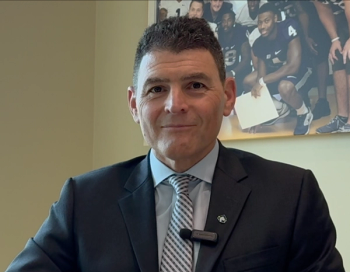
Dr. Michael Kupferman talks about the $50 million gift from the Golisano Foundation and joining an alliance of children’s hospitals.
Several women in leadership roles shared lessons they have learned, leading with empathy, and pursuing opportunities when they arise.
National Harbor, Md. - Women in leadership roles, including in the healthcare industry, often feel unnecessary pressure to be perfect.
During
Sophia Holder, executive vice president and chief financial officer of Children’s Hospital of Philadelphia, offered a telling response when asked what advice she would give to her younger self.
If she had the opportunity, Holder said she’d tell her younger self, “Perfection is a fallacy.”
Expressing a similar sentiment, Kirsten Largent, the chief financial officer of the OSF Healthcare System, talked about a lesson she has found valuable. Largent said another leader shared a message that she has remembered as she has weighed pursuing opportunities.
“Always be curious, explore your opportunities, and even if you don't think you are completely perfect and ready to move forward, don't confuse perfection with readiness,” Largent said. “And so that has always stuck with me.”
‘See yourself as a leader’
But she advised the women in attendance to recognize their own potential, regardless of their background.
“See yourself as a leader,” Jordan said, adding, “You're learners, you're doers, and you want to get better at what you do. See yourself as a leader and remember that.”
Women in healthcare leadership share that women sometimes talk themselves out of pursuing leadership roles they could do well, because they may lack one or two of the dozen criteria being sought for the role. Some women leaders often note that men often have the opposite mindset and will apply for leadership roles when they only have a couple of the many qualifications the organization is seeking.
Jordan cautioned women against selling themselves short for new roles. She says too many women hold off on pursuing promotions because they “do not reach or exceed every single qualification” in job opportunities.
Avoid comparisons
Karoline Mortensen, a professor at the University of Miami Herbert Business School, and a member of the HFMA board, says she now evaluates opportunities more carefully to determine if they really align with her goals and what makes her happy.
“I’m doing better about not saying yes to everything,” Mortensen said.
She said she serves on the HFMA board because she’s learning and bringing experiences that she can take back to her class.
But she also has learned to turn down other unpaid responsibilities that don’t necessarily relate to her love of teaching.
Mortensen says she also encouraged other women not to compare themselves to others, and to recognize success isn’t always a straight line.
“My path has been very nonlinear, and it worked out very well for me,” she said. “There are lots of times where I was looking around and saying, ‘Oh, you're doing this and you're doing that.’ Stay in your lane and don't be so focused on what everyone else is doing. You can only control what you're doing, and just let everything else just kind of fall inside.”
Empathy as a strength
The women on the panel also talked about empathy in leadership, and they said it doesn’t reflect a lack of strength.
As Largent said, “If I think about empathy and accountability, I don't think they're opposites. I think they work best when they go hand in hand, especially when there's difficult decisions to make.”
Largent said it’s important to have honesty and transparency about goals, but leaders can also express empathy to help get the most out of their teams.
“I know it's difficult, especially for women, to empower individuals to feel like they can step up, and you don't have to have all the answers,” Largent said. “You can go ahead and move forward, and be courageous, and ask questions and have that accountability, even if you don't have all the answers.”
Holder said that she thinks empathy strengthens accountability and can enhance performance.
“We are more than what we do, you know, as we enter those walls of our organizations,” Holder said. “And so I really try to stay centered on that, and see people that are working with me and for me first, because I believe if I'm doing that well, the work will follow. And we'll actually do much better work together, because we have built a foundation of trust that allows us to have really hard discussions about work, or hard discussions about trade-offs. And so I think empathy creates a space for us to find dignity with each other.”
Lifting others up
Women leaders often find themselves as the first women to hold that role. Holder is the first woman to serve as the CFO of Children’s Hospital of Philadelphia, and she says she also recognizes her importance as a woman of color in her role.
“I own that responsibility deeply,” Holder said.
She also said she saw her most important ability as developing talent.
“I want my legacy to be one where they feel they respect that when you engage with Sophia, she helps promote, she helps you to see who you didn't even imagine you become,” Holder said.
Largent also encouraged women to be willing to be vulnerable and to resist the temptation of feeling like they must have all the answers.
“It's not a sign of weakness to ask for help or to be curious, and I ask those questions,” Largent said. “I sometimes think some of the best leadership moments happen when people are not afraid to ask a question or to dig a little deeper, and that's really what gets the conversation going. So, have confidence, be courageous, and be curious.”