The question isn't whether to let AI into the patient journey. It's whether health systems will earn a seat in that conversation.
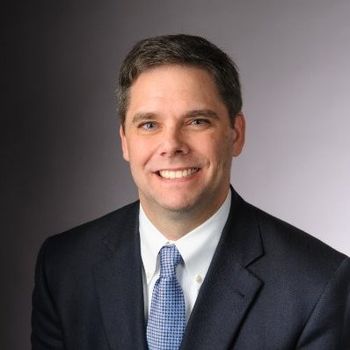
Matt Kull, chief information and digital officer of Inova, talks about the Virginia health system’s use of AI to expand capacity and get patient care more quickly.
The Inova health system has been finding success in using AI to help more patients get treatments and improve patient care.
Matt Kull, executive vice president and chief information and digital officer of Inova, is by his own admission an ardent proponent of the use of AI in healthcare.
But he also says Inova’s success stems from focusing on patients, working with clinicians and revamping processes before simply adding new technology.
Inova is a physician-led organization, and Kull says the system undertakes AI initiatives, and all technology projects, with the clinical enterprise in mind.
“At the end of the day, the clinical enterprise owns the patient outcome,” Kull tells Chief Healthcare Executive®.
“Technology is an enabler,” Kull says. “Technology is a structure creator. Technology is an automator, but it has to start up front with what's happening to that patient.”
Kull says that Inova’s approach to AI isn’t about “chasing headlines.” The system isn’t looking at solutions that look good but don’t provide much value.
“We want things that provide a lot of value, silently in the background, so that we can spend most of our time focused on our patients,” Kull says. “We leverage our technology 100% in service to our mission, which is really about making as much possible capacity for access for our patients, so that we can serve our communities.”
Winning at ‘Tetris’
Inova operates five hospitals and serves 4 million patients annually in northern Virginia and the Washington, D.C. metro area.
Inova has been working to reduce friction points across the system, and has been working to apply AI on administrative tasks, Kull says.
“We want everyone to be able to spend their time at the top of their skill set and not with the minutia that happens that takes up a lot of ‘busy time’,” Kull says. “And just looking at that, it's proven that there is an unlimited amount of things that we consider friction points where work is burdened by administrative tasks. And so that's where we start first.”
Inova has used AI to increase capacity. Kull points to the success in using AI to improve scheduling patients who need infusions.
Across Inova, the system typically did 160-170 infusions on a daily basis. He likens scheduling infusion chairs to “Tetris,” the classic video game.
“You've got blocks that fall, which are the patient need, and you've got space longitudinally where you can put them. Well, what happens is, you end up with these gaps, and these gaps become considerable,” Kull says.
Kull says the system has used AI to improve infusion scheduling, and now Inova is now handling 210 infusions per day. The system used AI to look at the historical times people spent in chairs and the times needed for a safe turnover, and the system added capacity without additional staff or real estate.
“Now we're seeing 40 to 50 more people a day for necessary medically critical infusions. That's just a technology play that anchored a better process to this specific business process,” Kull says.
He says it’s an operational function which may not sound sexy, but has tangible value and is reducing friction.
Accelerating surgery
Inova has also used AI to improve treatment for patients with hip fractures, speeding up the process for surgery. Kull says patients in the past waited three days between the confirmation of the hip fracture and surgery to repair it. With AI and an improved scheduling process, patients with hip fractures usually have surgery within 24 hours of the identification of the fracture.
Inova also has reduced the amount of time for hip fracture patients to get physical therapy. Those patients are moving to physical therapy at discharge, as opposed to the typical wait of four to five days.
“It's very coordinated, and it's a lot of people process that came together to look at each step of the way and come up with that gold standard, and then we anchor that pathway with the technology that we built,” Kull says.
Patients with hip fractures are seeing good outcomes with the revised process. The majority of patients say their quality of life is back to normal within six months, he says.
Kull says the system is taking that approach for patients with other conditions, looking at technology to identify gaps and help patients get safely discharged more quickly.
“It's really about simplifying the experience and getting people to a very favorable outcome as quickly as possible,” Kull says.
Centered on patients
Health systems that are expanding the use of AI need to understand that responsibility and trust comes first.
And he says that includes protecting patients’ private data as AI is used more broadly.
“If we're really taking that seriously, which we do at Inova, I think we have to approach this in a way that puts the most private, sensitive, protected information about each individual in a place that it is protected, used for good, used for their benefit, and that the work that we do puts the patient and the patient well-being at the center of every decision,” Kull says.
“We have a list of principles that line out the things that we will and will not do, and every single one of them asks the question: Is this the best possible thing we could do for our patient? And that's how we look at it,” Kull says.
As other health systems look to incorporate AI, Kull says leaders should partner with their technologists.
“We want to teach this stuff. We want to enable you to make decisions. We want to enable our business constituents to enable decision-making that has automation at its core,” he says.
With reimbursement pressures and inflation, health systems have to find ways to become more efficient, he says.
“We have to start thinking about how we drive efficiency into our organizations and continue to scale more and more population, more and more people. With an aging population, it means we're going to have more patients. And we're going to have to do it, more and more efficient, every day,” Kull says.
“Don't run from this,” he says. “It's happening, whether you want it to or not. Learn, get involved, partner with your technology teams. We want to help our business. I'm very fortunate here that I have an incredibly, incredibly curious leadership team around me. The rest of the executives at Inova are curious and they're hungry to embrace these capabilities, especially if it's in service to our patients.”