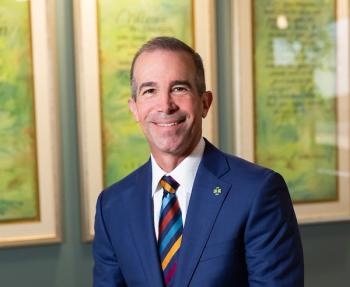

The leader of a 1,200-provider academic physician group talked with us about the seams of care, AI in the contact center and keeping physicians busy with the right patients.

The tech giant unveiled plans to partner with OpenEvidence on a new app at the HLTH conference in Las Vegas.
Apple looks to gain more understanding of how consumers are using AI to get information about their health.
The tech giant announced plans for a study with OpenEvidence at the HLTH conference in Las Vegas Sunday night. Thousands of healthcare leaders are in Las Vegas for the digital health conference.
The Apple announcement generated widespread media coverage. Here’s a quick overview.
Q: What is Apple planning to do?
A: Apple is working with OpenEvidence to examine how patients use AI to answer questions and get more information about their health.
“The Apple Health AI Usage Study, conducted in collaboration with OpenEvidence, will evaluate trust, comprehension, and real-world health AI engagement,” the company
Q: How will the study be conducted?
A: Apple says it’s designing an app to get more insights in how people are interacting with AI health tools.
Sumbul Desai, MD, Apple’s vice president of Health and Fitness, said the study will take place with “scientific rigor and clinical grounding.”
“Health is deeply personal, and conducting a dedicated research study is the most thoughtful way to understand how people engage with, comprehend, and evaluate health AI in everyday life,” Desai said in a statement.
“Insights from this study will help advance the broader scientific conversation and ensure that as technology evolves, we continue building trusted tools that genuinely support people wherever they are on their health journey,” she said.
Q: What types of questions can users ask?
A: Apple says consumers can ask basic questions about their health as well as more complicated questions.
Q: How will this differ from other AI tools answering health questions?
A: Apple touts the use of OpenEvidence’s citations from the latest peer-reviewed journals, such as The New England Journal of Medicine and the Journal of the American Medical Association. The app won’t provide the most popular answers but is drawing on genuine medical knowledge to give users the best answers possible, the company says.
Q: What does Apple hope to achieve?
A: OpenEvidence is used by doctors to get information on the latest research. By teaming with OpenEvidence, Apple is aiming to help people easily get answers that are based on medical studies.
“The study brings together medically grounded AI technology developed by OpenEvidence with an Apple-designed research experience,” the company says.
Apple says some AI health tools don’t always offer complete information, and the company says the study is designed to help provide people with better information.
“The study will also explore how health AI can potentially help participants better prepare for clinical visits with their own doctors,” Apple says.
Q: What if patients need more information?
A: Apple says if there are responses that yield cause for concern, users will be advised that they may want to talk to a healthcare provider.
Q: How big is the study?
A: It is open to up to 200,000 eligible participants across the nation, Apple says. Participants must be at least 21 years old.
Q: What do users need to participate?
A; Apple says users must have an iPhone 15 Pro or later, running iOS 26 or later.
Q: What about privacy protections?
A: Apple says the study is being designed with a host of guardrails to ensure private health data is protected. Apple also says study data won’t be used to train AI models. Participants will be able to say if they want to share survey responses.
Q: How big is OpenEvidence?
A: Clinician usage of OpenEvidence appears to be surging, as evidenced by
In January 2024, OpenEvidence had 355 monthly users. In June 2026, more than 703,000 were using OpenEvidence on a monthly basis, the study found. The average user submitted nearly 40 queries per month.
Q: Are Americans asking AI questions about their health?
A: A growing number of Americans are turning to AI to learn more about medical issues. Roughly one in three Americans are asking AI health questions, according to
Q: Are most doctors using AI?
A: The question has a different answer than it would have just a few years ago. Four out of five doctors are using AI in their practice, up from 38% in 2023, according to an