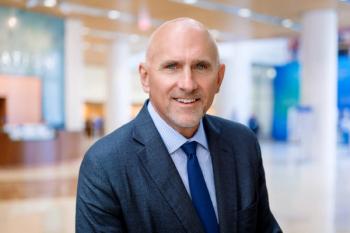
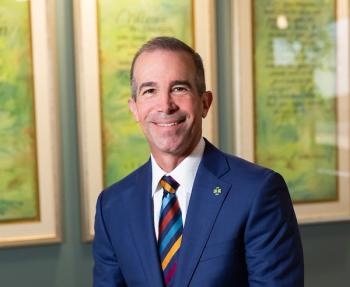
Matthew Cantonis
Senior vice president and chief operating officer, USF Tampa General Physicians
- Also serves as: chief access officer for the Tampa General health system
- At USF Tampa General Physicians since: 2022, when he was named the group’s first senior vice president of operations
- Before USF Tampa General Physicians: more than a decade with Scripps Health in San Diego
USF Tampa General Physicians at a glance
- Academic physician group launched in January 2022 by USF Health and Tampa General
- Brings together University of South Florida physicians and Tampa General Medical Group
Q: You lead a large academic physician group and also serve as the health system’s chief access officer. How do you describe your role, and how does the physician practice side support the broader health system?
Cantonis: “I'm the COO of USF Tampa General Physicians. We're about a 1,200-provider practice that has brought together the University of South Florida and Tampa General Medical Group into one physician enterprise. I also wear the chief access officer hat for our health system, which gives me the accountability of both making it easier to get care and making it easier for our team to deliver it. That means I'm the throat to choke on both of those issues, which can be substantial.
“Our system saw almost 1 million patient encounters on the outpatient side last year. It's about 10 times the amount of inpatient encounters we had. I like to think of us as the fuel that feeds the academic medical center engine. If we are high-octane, that engine is firing on all cylinders. When we don't get our job right and aren't triaging patients correctly, or connecting patients to the right needs at the time they need it, the first time they need it, we kick inefficiency down throughout our system's infrastructure.
“So I see us as one of the most important components of a health system in terms of making sure that the patient journey is clean and that our system is healthy.”
Q: Scheduling, referrals and wait times are where patients often feel access problems the most. What changes have made the biggest difference?
Cantonis: “This is the most unglamorous answer. When you talk about what needs to be changed in the way patients experience access, it is really a small, detailed, painstaking initiative: slot by slot, provider by provider, session by session, clinic by clinic. It's analysis around where your demand is and how well the tools you use to connect patients to the right place match it.
“We oftentimes build static tools for dynamic problems in healthcare, and scheduling and referral management is exactly that. We look at demand, we look at what we've produced over the last six months, we make some template changes, and the day they get implemented, our demand is already different than what it was six months ago.
“So making a big improvement in connecting patients to care means being more dynamic, being more adaptable, moving things around in more real time, and giving care that changes, and sometimes urgently needs to be redirected, a place to land.”
“We oftentimes build static tools for dynamic problems in healthcare, and scheduling and referral management is exactly that.”
Q: Physician recruitment and retention is a challenge for many groups. What helps you attract physicians and keep them?
Cantonis: “We're blessed to be in the Tampa Bay area. Physicians love the state of Florida's tax structure. They also love a beautiful coastal area and access to a large university academic medical center. So we have a very attractive product from a recruitment standpoint.
“But physicians burn out when they feel the same inefficiency that our patients experience. They actually want to be busy. I've always found that physicians are happiest when they're busiest, but if they're inefficiently full, they get very frustrated. So I think the best retention strategy is actually a good access and scheduling strategy: making sure they're seeing the patients they have trained to see, the patients they are world-class experts in helping. They have a purpose. They've been trained to do a specific set of skills. When you fill them with something else, it is extraordinarily frustrating.
“From a recruitment standpoint, your scheduling algorithms and logic can be very helpful, too. You can actually fill new providers up much more quickly when the rules are set up right and up front. So one of our largest recruitment and retention strategies is making sure providers are seeing the patients they were trained for and filling them up quickly, so they can understand how to help us make them even more efficient down the line.”
“I've always found that physicians are happiest when they're busiest, but if they're inefficiently full, they get very frustrated.”
Q: How are you using technology, including AI, to improve access or reduce the administrative burden on physicians and staff?
Cantonis: “We have had a large AI deployment in our contact center, where patients go first for scheduling. In a little over a year, the AI has answered 2.5 million calls. A little less than 20% of those are being resolved autonomously, and we need to get that rate up. But that's helping our human agents do more meaningful work on the back end.
“One of the things we found, which has been so impactful and really guided AI deployments around our system, is that the high-volume, low-value task was easily automatable through the AI technology. The more complex and difficult task was actually where our agents found the most value in the work they did.
“They answer the phone with the same hope and vulnerability that our patients call us with. When they are able to resolve that, and know that they have a little bit of extra time to do that because they have an AI support system taking on some of the calls in the queue, they can give more time to the patient in front of them and deliver a higher-value service and, most likely, a more highly reliable appointment that matches the patient's need.”
Q: How do you work with community and private practice physicians to expand access across your region?
Cantonis: “This is, I think, the way of the future. In the past, we would buy practices, or health systems would aggregate. I think partnering, whether it be with physician practices in the community or collaborating in joint ventures with different partners around the ecosystem of healthcare, is the way of the future. It's something that's in our DNA at Tampa General, and some of our partnerships have done phenomenally well.
“We are a quaternary and tertiary center with highly subspecialized physicians. We have some community partners that jump in and help when demand outstretches those particular providers. We work with our patients to provide them choice, let them know we have a preferred network, and triage referrals as appropriate. It's always based on clinical appropriateness. It's always in network first if we can, but it helps close the loop on referrals.
“In the past, a provider who referred to us would probably never hear again. Now we're closing the loop and telling them, ‘Hey, we got your referral, and this is what we did with it.’ And that little bit of trust at that seam between the provider and our practice helps earn the relationship and build it even stronger.”
Q: Is there anything else you’d like to talk about?
Cantonis: “One of the themes of this conference has been access. It's been access and AI, and what I'm going to walk out of here understanding is that access needs an owner. It sits somewhere between [revenue cycle], clinical operations and physician leadership, and if there isn't an owner of access, then nobody owns it. I'm excited that our system has taken a step forward and anointed an officer to be accountable for this, and I think the work ahead has a chance to really differentiate us.
“Access will continue to be a problem. It'll be a theme of next year's conference as well. There are impending provider shortages and staff shortages that are going to make us learn how to work differently and partner with some of these AI tools that can do things for us that we've never been able to do before. Understanding our demand so we can be more dynamic and meet our patients' needs feels like it's right at our fingertips.
“In the next couple of years, if we're able to do that, scaling our resources over a much broader population will be achievable, and the results will be fiscal security for our systems, better patient care for our patients and a healthier community. And I'm excited for that.”
Q: Physicians are among the most trusted voices on affordability and access, but they’re rarely tapped to have those conversations outside the exam room. How are you encouraging physicians to engage with policymakers, employers and others whose upstream decisions affect patients’ access?
Cantonis: “There's a great quote that says, ‘Don't confuse the intent of a policy or a practice with the outcome.’ You will only understand that once you flow it through. Investing in the right inputs upstream when you're doing process development is going to be key for this, and the physician voice at that table, in addition to our key nursing partners and other clinical leadership depending on the particular topic, is critical for us to get all of the aspects of it right.
“There are so many things in healthcare that don't make intuitive sense. But there are also so many smart people who, when they're put in the same room together with differing perspectives and really good data, can come to a very reasonable and logical conclusion. So I think developing a system that allows physicians to have that input up front is how you get to a better future state.”
(Jennifer Dye conducted the interview in Chicago. Ron Southwick and Austin Littrell contributed.)