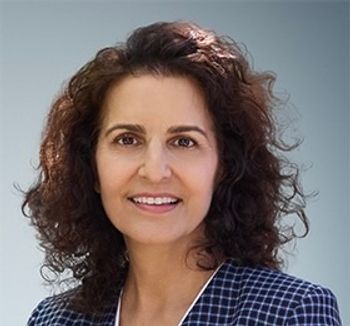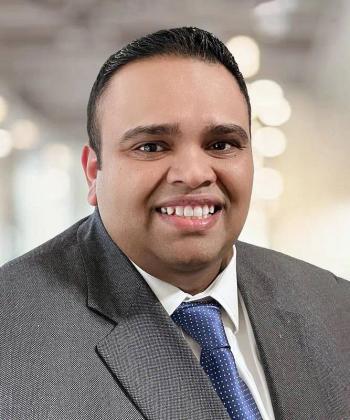

Dr. Myechia Minter-Jordan came to the conference to push for technology aimed at helping seniors live better.

The digital health conference showcased the latest tech and tools, but enthusiasm is also mixed with anxiety about mounting financial pressures.
Las Vegas - Perhaps it’s fitting that this year’s HLTH conference took place just before a huge F1 racing weekend takes over Sin City.
After all, the healthcare industry continues to change at dizzying speeds. HLTH leaned into the F1 event, from artwork to racing-themed stages (such as the Ferrari and Velocity stages for sessions).
The conference also came amid widespread tech problems, including the FAA groundstop one week ago that prevented planes from taking off for hours. Even though travel headaches prevented some from attending or delayed some arrivals, thousands of people still made it to the event.
While many are excited about the future and new capabilities with AI, healthcare leaders say they’re very worried about growing financial challenges in the coming years.
Here’s my rundown based on interviews and casual conversations at HLTH.
AI has dominated the HLTH conference like never before, and it’s been the big topic at the show for years. HLTH has an AI Zone, but almost every vendor seemed to be describing its technology as powered by AI.
Dr. Darryl Elmouchi, chief operating officer of Providence, may have had my favorite line of the week when he said he expected someone to hold up a pencil and say it’s AI-enabled.
But with so many tools and solutions incorporating AI, tech companies probably need to understand that describing a product as “AI-enabled” isn’t really a differentiator.
Interestingly, one CEO says when he reviews press releases, if the phrase “AI-enabled” or something similar appears, he’s telling them to cross it out.
Certainly, excitement about AI abounds. Even with all the tech-related outages over the past week, those in attendance expressed boundless optimism for AI.
Dr. John Whyte, CEO of the American Medical Association, told Chief Healthcare Executive® that he’s incredibly enthusiastic about AI’s ability to help doctors do better for their patients. He added that doctors who don’t use AI run the risk of being placed.
But he emphatically pushed back against assertions that AI is going to replace doctors.
“That’s not what’s going to happen,” Whyte says.
Whyte says he is concerned that as AI is more widely adopted as a tool to improve efficiency, doctors are going to be pushed to see more patients. He says he’s hoping times savings from AI can help doctors perhaps spend more time with patients or considering the best treatment.
Many at HLTH says AI tools are maturing, moving from drawing boards to deployment. Some say one difference from previous years is some AI companies now have a track record that can be evaluated.
Healthcare leaders are increasingly demanding to see the ROI on AI. The buzz to pick up a new digital tool is more often being replaced by questions about what makes a vendor’s tool different and if it’s actually solving a problem. And they’re asking for proof.
To that end, health systems and hospitals are signing shorter contracts with companies selling AI products with clear benchmarks, several executives and vendors told me. Some systems have opted against multi-year agreements and are signing deals for a year or less. A couple said they’ve heard of contracts for six months and even three months.
Health systems are bracing for more cost pressures in the coming years.
Medicaid cuts in the coming years are poised to deliver a blow to hospitals. Millions are expected to lose coverage, forcing systems to treat more uninsured patients. Health systems are already uninsured patients with fewer Americans being covered by Affordable Care Act plans, due to the expiration of tax credits and surging premiums.
Medicaid cuts could potentially force the closure of up to 1,800 community health centers, says
He’s hoping the new Congress will help provide more support for primary care, and community health centers. He also urged hospitals to partner more with community health centers.
Still, the troubling financial climate is on the minds of many, and a few observers told me they thought the mood at HLTH was more “muted” than previous years.
Several healthcare leaders say they are seeing more support for value-based care, particularly in light of the daunting financial pressures.
“I think value-based care is in its moment,” Ansari says.
With more uninsured Americans in the system, and an aging population (more on that coming up), more healthcare leaders say the shift to helping people stay healthier, or as healthy as possible, isn’t just an aspirational goal. It’s a necessity. But the government will need to help provide the right incentives.
It’s no accident that
“As we think about our lives and our lifespan, we also know that as we're living longer, we're not necessarily living healthier years,” she says.
More than 120 million Americans - more than one-third of the U.S. population - are 50 and over. So she has a point in saying there’s a big market in health products aimed at older Americans.
AARP has formed
With women making up more than half of the population, it’s puzzling that investments in women’s health have been so meager for so long.
In recent years, more money is going into women’s health.
“I'm seeing technology, innovation, pharma, investors,” she says. “This is a real opportunity for all of us, frankly, to get it right and to make up for decades of less than optimal care for women.”
It hasn’t been the easiest environment for those working to close disparities.
She says some organizations remain in the fight, but she’d like to see more efforts to help underserved communities.
“I do see health systems still working on health equity,” she says. “I wish there were more.”
Amid some anti-DEI sentiments, health systems are rebranding their health equity programs as population health. But Blackstock says, “I care less about the name or the terms being used than the actual work.”
We’ll have more stories and videos featuring our conversations with top healthcare leaders at HLTH in the coming weeks.