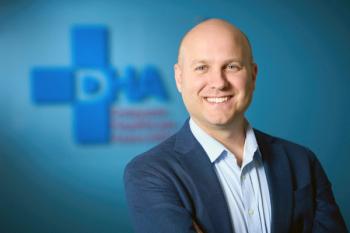
Brian Frazee, president and CEO of the Delaware Healthcare Association, talks about funding challenges and serving a growing population.
In a new episode of our video series, we discuss a partnership with the Johnson & Johnson Foundation and Google to boost AI skills in the nursing workforce.
The American Nurses Enterprise is working to help nurses, particularly those in underserved areas, utilize AI more effectively.
Google and the Johnson & Johnson Foundation recently gave the American Nurses Enterprise grants totaling $5 million to bolster AI skills in the nursing workforce. The American Nurses Enterprise includes the American Nurses Association, American Nurses Credentialing Center, and American Nurses Foundation.
We talked with Dr. Brad Goettl, chief nursing officer of the American Nurses Enterprise, about the work to help train nurses in using AI in the latest episode of Changes, a video series from Chief Healthcare Executive®.
Goettl says the primary focus of the three-year grant will be improving AI skills for nurses in underserved regions, including rural communities and urban areas that are under-resourced. But he says the content is being shared broadly.
“We are opening the content up to all nurses because we understand that this is really an area of growth for every nurse across the country, especially as AI is integrated into our practice,” Goettl says.
In a wide-ranging conversation, Goettl discusses the importance of nurses developing critical skills in the use of AI and how AI is changing the practice of nursing. He stresses that AI is a supplement - and not a substitute - for nurses. He also outlines the way health systems and hospitals should be thinking about AI and nursing, and the need for nurses to have a vital role in the use of AI.
Here are some excerpts of the conversation. Check out
Q: Let's just start talking about the $5 million contribution from Google and the Johnson & Johnson Foundation to American Nurses Enterprise to help bring AI training and education to nurses in rural and underserved areas. What are some of the areas that you're hoping to address?
A: “We are grateful for the opportunity to partner with Google and Johnson & Johnson on this initiative. Their focus on expanding professional development, upskilling nurses related to AI, and how they can incorporate the use of AI into their everyday practice is clear from this grant. And we were, like I said, grateful that they asked us to participate.
“Our goal is to reach a bold 250,000 nurses across the country, primarily from rural and underserved areas. But we are opening the content up to all nurses because we understand that this is really an area of growth for every nurse across the country, especially as AI is integrated into our practice.
“So the grant will help us build the infrastructure needed to deliver core education, upskilling products, resources that will help nurses be able to implement AI into their everyday practice, but also be able to provide some guidance around governance and how health systems should be incorporating nursing into the decision-making around AI. And the grant will also then help build out some of these courses and provide some additional thought leadership and expertise within ANA to help us maximize that reach.”
Q: Well, you mentioned this is going to be primarily rural, remote areas, but there are certainly some underserved areas in cities and safety-net hospitals as well. So is some of this going to be helping some nurses working in those types of settings?
A: “Yeah, most definitely. It's not going to be restricted. We have a goal to reach rural and underserved areas. We understand that many underserved areas are in urban areas. A lot of healthcare provider shortage areas and nursing shortage areas are in urban, urban-adjacent, and suburban areas as well. So the more reach we get, the better. The courses will be applicable to any nurse in their practice, no matter where they live and the environment they work in.”
Q: I want to talk a little bit more about some of the challenges rural hospitals and health systems are facing — it's been a challenge for years in that environment. So I was wondering if you could talk a little bit more about how AI can help tackle those challenges, how it can help nurses deliver even better care.
A: “I came from a rural community. My first practice was in a small town in central Wisconsin. The nurse wasn't just the nurse. You were the unit clerk. You were the person who helped register overnight. You would pass trays when you needed to pass trays. Sometimes you were doing billing documentation, or all kinds of stuff that, at a large urban academic center, a nurse may not necessarily be dealing with on a day-to-day basis. And so some of this technology may help with that as well, some of those administrative, logistical, operational functions.
“I think some of the challenges in rural areas … we still have spots where broadband is difficult. We have skepticism around technology, which is not unique to rural areas, but in general. And then there's a cost, which resource-limited areas sometimes aren't able to access the amount of technology resources that a heavily-resourced institution would have at their fingertips.
“And so I think that we're seeing a lot of industry coming forward with solutions, and we're hopeful that those solutions are really solving the problems that nurses are dealing with every single day and not just adding an additional tool that's not useful. And I think in the rural environments, there's a lot of opportunity where AI, and just digital technology in general, emerging technology in general, can improve access to care.”
Just a reminder that you can find audio versions of our “Changes” series wherever you get your podcasts.