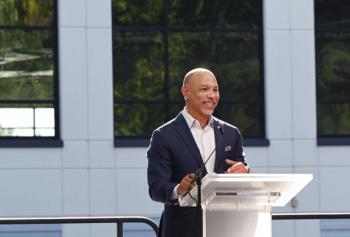
He spoke with us about plans to invest nearly $600 million in the Minnesota system, upgrading facilities and the alignment between the organizations.
Dr. John Deeken of Inova Health talks with us about the benefits for patients and hospitals, the results of a recent study, and offers advice for health systems looking to adopt the model.
At first blush, the idea seems simple and straightforward.
Instead of having cancer patients go to several different appointments over a number of days, consolidate the appointments in one day.
The Inova Health System in northern Virginia and the suburbs of Washington, D.C. has utilized this approach for 10 years. Inova’s Schar Cancer Center offers a same-day, multidisciplinary clinic so patients are seeing cancer specialists in one day.
Dr. John Deeken, president of the Inova Schar Cancer Center, says the same-day, multidisciplinary cancer clinic offers a better model for patients.
“We knew, from a patient experience standpoint, it was a lot better to say, ‘Here's what's to come. All the doctors will be here taking care of you. We'll come up with a plan together,’" Deeken tells Chief Healthcare Executive®.
Now, a recent study offers more evidence to the benefits of same-day, multidisciplinary clinics for cancer patients. Those clinics lead to better outcomes, earlier treatment, higher patient satisfaction, and potentially better chances of survival, according to the
Researchers produced a meta-analysis of 27 studies of results, including 17 academic medical centers and 10 community hospitals. Their study encompassed more than 18,000 patients.
Deeken, one of the authors of the study, says he’s encouraged by the results. But he says it makes sense that if all the physicians are seeing the patients at the same time, comparing notes and reviewing pathology and radiation results, then patients can begin treatment sooner and see better outcomes.
Patients are more likely to adhere to clinical guidelines. By embedding clinical research staff into the process, Deeken says there’s higher enrollment in clinical trials.
“All of that should lead to better outcomes, but it was interesting to see that it did,” he says.
Deeken says he hopes more health systems consider using the same-day clinic model, which he says isn’t common.
“I would definitely say it's the exception, not the rule, in 2026,” Deeken says.
Starting treatment sooner
By gathering doctors together at the outset and developing a coordinated plan, patients are more likely to start treatment sooner, the study found.
Deeken says an earlier start for cancer treatment is critical to giving patients a better chance for recovery.
“For most cancers, the sooner you start, the better it is, because the cancer has had less time to spread and metastasize,” Deeken says. “That differs by different cancers, but in general, the earlier we catch a cancer the better, the sooner we start treatment the better, and this study would certainly reinforce that idea.
Patients express more satisfaction with the same-day clinic model, Deeken says. It’s potentially a longer day for patients, since appointments could last a few hours.
But he says it’s far more preferable than patients having multiple appointments over several days to see individual specialists separately.
The same-day clinic model allows more time for patients to rest, as opposed to the hassle of driving or arranging rides to multiple appointments, which can be taxing for patients who already aren’t at their best.
Reducing hassles, lowering costs
The model also lowers costs for patients, since they’re spending less on traveling to appointments. And Deeken says that can make a difference for patients who may be traveling an hour or more to the clinic.
“Even in areas where patients might have to drive far to get to their doctors, the cost to patients was actually lower in the studies that looked at that question,” Deeken says. “If you had fewer days where you have to travel from afar to see a doctor on this day and then a different doctor next week, and instead you see them all in one day, the cost to patients was lower too, which we were pleasantly surprised by.”
The same-day clinic approach can also reduce costs for hospitals and payers, Deeken says. With the various oncologists talking together on specific cases, Deeken says the model can reduce unnecessary tests, which lowers costs. He says there were fewer unneeded radiology studies.
“That cost actually went down because they were ordering only what they should need and what they did need,” Deeken says. “Not everyone was ordering their own thing.”
“It is a reduction of cost to the patients, and actually a reduction of cost to the system as well,” he says.
Building support from doctors
When Inova initially moved to the same-day, multidisciplinary model, Deeken says some doctors were skeptical. When some physicians first begin working in the model, Deeken says some are worried that it will be less efficient in terms of scheduling appointments. He says that has been the “biggest hang-up” for some physicians.
Some doctors resist because they think they’ll be able to see more patients at their own clinic, rather than gathering with other oncologists at a multidisciplinary clinic.
The multidisciplinary model is more efficient, Deeken says.
“Physicians think it takes more time, but when we've looked at it, we actually think it's a more efficient use of physician time,” Deeken says. “Because if a patient is seeing doctors at different places at different times, then the doctors have to spend a lot of time messaging each other or calling each other.”
As physicians get accustomed to the routine, they get on board, he says.
“Once they're bought into the system and have made the adjustments to their schedule, to their flow, then it's all moving forward,” Deeken says. “No one wants to look back and go back to the old way.”
Advice for adoption
Health systems looking to adopt the same-day, multidisciplinary model should begin gradually, Deeken suggests.
“Start in one area — one pilot, one specific disease,” he says. “Find some champions who really want to do this, or believe in it, or want to give it a try, and see how that evolves.”
Hospitals could begin with trials of breast cancer, for example, and compare data before and after adopting the multidisciplinary approach. Health systems can begin with simple metrics, such as the time when patients began treatment and patient experience scores.
“I wouldn't try to boil the ocean all at once — start in one area, find some physician champions, and give it a good six months at least to see if it works,” Deeken says. “And then, hopefully, if you saw the benefits, you could convince colleagues in other disease areas to take it on as well.”
Hopes for a new standard of care
Some cancer patients may not need to see the whole multidisciplinary team, Deeken says. A patient with an early-stage cancer may just need to see a thoracic surgeon, while a patient with a metastatic disease may only need to see a medical oncologist.
But Deeken thinks most cancer patients will benefit from the multidisciplinary model.
“We think the outcomes argue that this should be a standard of care, even though it's certainly a minority of places around the country that do this,” he says.
Deeken says he hopes to see more health systems adopt the same-day, multidisciplinary care model.
“I think we're a couple innings into the game of getting this to be the standard of care in the U.S. for cancer patients,” he says. “And it's something we need to keep pushing on, to show that this is best for patients, as cancer care has gotten so complicated and so multidisciplinary. My hope is that over the next 10 to 20 years, this becomes the standard of care wherever you are in the U.S., and maybe elsewhere as well, because the outcomes are clearly better.”