The pace of mergers isn’t showing signs of slowing down, as health systems engage in more deals and bigger transactions.
Corewell Health CEO Tina Freese Decker and CFO Matt Cox talk about the need for candor, trust, and even a bit of tension in making big decisions at the Healthcare Financial Management Association conference.
National Harbor, Md. - With health systems facing considerable financial pressures and a rapidly changing industry, the relationship between the chief executive officer and chief financial officer matters more than ever.
During the first day of the Healthcare Financial Management Association conference, Tina Freese Decker, the CEO of Corewell Health, and Matt Cox, the system’s CFO, talked about their partnership and how they tackle tough decisions in a discussion on stage. Corewell Health operates 21 hospitals in Michigan.
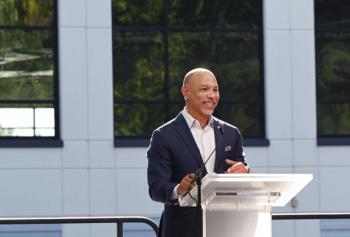
Joe Fifer, the HFMA’s past president and CEO, led a discussion Sunday exploring the nuances of the relationship between chief executive officers and chief financial officers. Fifer is also a member of Corewell Health’s board of directors.
Cox, who just began his term as the HFMA’s chairman, says Freese Decker isn’t looking for positive reinforcement.
“The CEO doesn't want to hear what they want to hear, they want to hear the truth,” Cox said. “And Tina will come to me and ask questions, and what I've been surprised about is how she wants to dig in and she wants to understand and she wants to know the why’s.”
Freese Decker concurred that she needs honest assessments from her chief financial officer.
“I want the truth,” she said. “He has to be completely honest with me, very candid, come in with scenarios, not just complaints, and help us figure out what the path forward is as we move forward.”
“I think that there is a way to have this relationship as a confidant discussion, …. but it's a conversation about the future of healthcare, the future of the organization, where it’s driving to, to ensure that financial plan and the strategy plan align in that way. But it has to start with candid conversations and trust, and that's what Matt and I have developed.”
Cox said he values that he can go into Freese Decker’s office and “say pretty much anything. But he added that in some conversations with his CEO, Freese Decker will occasionally advise on if something shouldn’t be said in a big group.
Still, Cox said it’s important for the chief financial officer to be able to have the ability to speak freely.
“I think that when, when that doesn't happen, it's when CFOs start to become ineffective,” Cox said.
“I don't go in and just complain or bring in ideas without doing the homework,” he continued. “I go in and we have meaningful conversations. Sometimes we agree, and sometimes we don't agree. But when we walk out of the room, we agree, and I think that's really important.”
Fifer asked about how they deal with disagreements. Cox said a certain amount of tension is a reality, given the nature of their roles.
“If there's no tension at all between the CEO and the CFO, then neither are doing their job,” Cox said. “I think if Tina always said yes to me, that wouldn't be good, and vice versa.
“We definitely have had tension, and there's been times where I think Tina has been so frustrated with me that I think about, what should I take home out of my office tonight, because I might not be able to come back tomorrow,” Cox said jokingly. “But I think that there are definitely conversations where there should be elevated tension, and then there are times where there shouldn't be, and I think that having both is important.”
Freese Decker says tensions are simply the reality of leading a large health organization, along with running a system that delivers healthcare and also operates a health plan.
“The important part is that you work through it, and that's where I think healthy debate is really important to get down to the candidness to understand what is the problem that we're trying to solve, and how do we then solve that problem,” Freese Decker said.
In cases where there are disagreements, Cox said that they never end the conversation mad at each other or thinking that the other doesn’t get it.
He said there may be times where he needs to get more data, and more opinions, on a certain issue.
Cox also credited his CEO for making sure he’s not always the one to bring the bad news on an issue involving money.
“Sometimes we strategize about that, sometimes in those early morning catch-ups before everybody else shows up, we'll have a conversation, and Tina will say, ‘Well, maybe I should be the one to say that this time,’” Cox said.
And Cox said that he would hate to be a chief financial officer that said “no” all the time.
“I think that that would be a very boring job, and I would be ineffective, because I want to make things better,” he said. “I want to help our health system grow.”
When she introduced Cox on stage, Freese Decker explained that he is more than someone who is good with numbers.
“In my opinion, Matt is more of an idea guy,” she said. “The numbers come easy to him, but so do the unique ideas that match the numbers to the operations to create innovative solutions to solve some of our toughest problems. He knows what matters most, and that is the people we serve and those who serve them.”