
Dr. Myechia Minter-Jordan came to the conference to push for technology aimed at helping seniors live better.
He talked about efforts to reduce violence against doctors and nurses and how the system earned a top ranking as a great place to work.
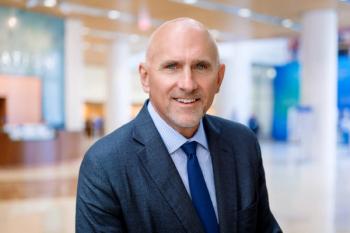
Chicago - Few people can say they have led a health system for more than a quarter of a century.
Chris Van Gorder has served as president and CEO of
Van Gorder attributes Scripps’ high ranking in part due to the system’s extensive efforts to reduce violent attacks on doctors, nurses and other staff. Van Gorder has seen violence firsthand. Early in his career, when he worked as a hospital security guard, he was stabbed by a patient.
A former police officer, Van Gorder has worked extensively with local law enforcement agencies to prosecute those who assault staff, and employees are encouraged to report violent incidents.
“We started doing wide educational programs and started to really convince our employees that it was important to report these and that they would be supported by the organization,” Gorder says. “They'd be supported by law enforcement. They'd be supported by the district attorney's office. And the mood in the organization was dramatically different.”
Van Gorder sat down with Chief Healthcare Executive® in Chicago while he was in town for the Becker's CEO + CFO Roundtable. He talked about his early years with the system, overcoming resistance from skeptical staff and getting support from physicians and others across the organization. He recounts the efforts to get Scripps’ hospitals to work together as one system.
He also talked about the growing financial pressures with cuts to Medicaid programs, including projected losses of up to $100 million over three years.
This is another installment in our series of conversations with C-suite leaders. Look for more in the coming days.
Q: You're speaking at Becker's about violence against healthcare workers. How serious has this problem become for your nurses, physicians, and staff? And when did you decide Scripps had to treat it differently?
Van Gorder: “Well, violence in healthcare has been around for a long time. In fact, very early in my career, as I was working my way through school, I was a hospital security officer, and I was stabbed by a patient. Never got reported anywhere, like a lot of these incidents were. I just went down to the emergency room and got sewn up, and, you know, went back to work. So there's always been a certain level of violence.
“But I think post-COVID, we noticed it picked up dramatically. During COVID, we were all heroes. How many people were out with pots and pans, thanking all the healthcare workers? But boy, it changed afterwards, and we've seen a sudden rise in violence. So I think the statistics really are about one in every five healthcare employees is going to be assaulted at one time or another. If it's in the emergency room, those numbers are much, much higher than that. So healthcare violence has been around for a long time, and frankly, I got tired of it.”
Q: Scripps helped start a task force in San Diego that brings hospitals together with the district attorney, the city attorney, and police. How did you get prosecutors and police to take assaults in hospitals more seriously, and what has changed since?
Van Gorder: “Well, I knew that we couldn't do this as a hospital. I think that's what every hospital does: tries to take on their violence issues wherever they happen to be, all on their own. This is really a community issue.
“I'm a former police officer that was injured in the line of duty and retired, and that's what got me into healthcare. And I spent 20 years with the sheriff's department in San Diego County as a reserve deputy. I retired as assistant sheriff, so I have a few contacts in the law enforcement world. So I made a decision to go to the San Diego Association of Police Chiefs and Sheriff, where all the law enforcement leaders meet on a regular basis, including federal, state, and local law enforcement officers. I was given five minutes to make a pitch that they needed to take healthcare violence a lot more seriously than they had been doing. I went over the statistics, etc., and the normal reaction I got from the law enforcement folks was, ‘So? I mean, you know, no big deal.’
“But the district attorney was there, and I could see her leaning into this conversation. She had no idea how much violence was taking place at all; those cases were never making it to her. So we ended up talking afterwards, and she ended up deciding with us to create this community-wide task force. So we invited all the leaders of the local law enforcement agencies together, all of my counterpart CEOs around the community, along with the district attorney, and because she was going to participate, they all came. I think if I had just put out an invitation, some would have come, some wouldn't have come. And I said, we've got to take this whole issue on as a community.”
“The DA did her own research and found out that a lot of these cases, well, first of all, the cases weren't getting reported. Just like when I got stabbed, there's no report. And the reason there's no report is a lot of healthcare workers don't think it's going to go anywhere, or,’"We're healthcare workers. Why would we want to prosecute one of our patients?’ So a lot of those are just misunderstandings.
“Well, she did her research and found out there are a lot of cases that were getting reported but never made it past law enforcement to the DA's office. And misdemeanors, the battery cases, would go to the city attorney's office. Same case, not going there at all. Maybe a handful at best. She brought those statistics to all the law enforcement officers and others, and started talking about the fact that healthcare workers need to understand that just because they report it does not necessarily mean somebody's going to go to jail, but the courts can mandate behavioral care or chemical dependency care. There's a lot of things they could do to actually reduce the amount of violence in the community.
“So in the end, she formed a task force in her own unit that just prosecutes healthcare violence. So now there's specialists in it. The police departments are starting to really write the reports, because we really encourage our employees to report it. And we did education that in many cases these will be pled out. They won't have to go to court or anything like that. And that victims have rights. They have rights as well. And there's monetary compensation if necessary under the state of California. A variety of things that they didn't know.
“So we had the police departments coming and doing, you know, pastry with a cop or whatever it ended up being. I know it was Danish with the DA. And we started doing wide educational programs and started to really convince our employees that it was important to report these and that they would be supported by the organization. They'd be supported by law enforcement. They'd be supported by the district attorney's office. And the mood in the organization went dramatically different.
“We've been one of Fortune magazine's top 100 employers now for 18 years in a row, but we had dropped down the year before last to 98, about ready to fall off the list. We jumped up this last year to 26, a jump of 71 spaces on that list in one year, and I would attribute that to the fact that the employees really believe that our organization is trying to create an environment where they're going to be safe, that they're going to be supported. And I think that contributed to our big jump as the number one healthcare organization on that Fortune 100 list in the country.”
Q: If a CEO in another city wanted to build that kind of partnership with law enforcement, where do you think they should start, and what would you tell them to avoid?
Van Gorder: “Well, my guess is most communities have a similar kind of organization where all the police chiefs and the prosecutors get together and talk about these dynamics. I would start there, just exactly like I did. Or if they have a contact within law enforcement, they could say, ‘This is a real issue. Could you come and help us with this?’ And we need to bring in other law enforcement agencies to support us as well, or the DA or the city attorney. Use us as an example of how we can actually reduce the number of incidents.
“One of the things that we've got now is our number of incidents have gone up, because now the employees are willing to report them. We encourage that. I mean, now they're reporting touching that's inappropriate. Well, nurses have been touched a lot of times by patients and others. Well, that's inappropriate. And the city attorney and the DA said that's inappropriate. Those should be reported as well. So the number of reports have gone up, but the injuries have dropped dramatically. I think it was around 31% the first year we did this, another 21%, and you would expect that to go down over time because the number of incidents have dropped. And that's perfect evidence that what we're doing is working.
“Now we're doing a lot of training with our employees as well, how to calm the situation down, as opposed to doing what a lot of healthcare workers do, which is rush right in. I mean, cops will look back; it may have taken five officers to take somebody into custody. They bring them into the hospital, and the nurse and the doctor immediately take off the handcuffs that took five officers, and they wonder why they get hit. So now we teach them: there's 10-5-2. At 10 feet, you stop, make contact, look around. Does it look like this is a situation that could get out of control? If that's the case, back away, get some additional help. You get to the five-foot mark: okay, make contact with the person. Tell them what you're going to do. Is it okay with the patient? And if there's hostility, whether it's with a patient or with a visitor, back away, let's get some additional help. And at two, of course, you do that as well.
“I taught first responder medical response for years with the sheriff's department, and we always taught them the number one thing you do is scene safety. And as a cop, I always laughed. I mean, the cops would run in, the firefighters would walk in. Why were they walking in? They're doing scene assessment. What do I have? Do I need additional resources? All of those types of things. Hospital workers just rush in. Well, now we have them go in slowly, unless somebody's having a cardiac arrest or something. Well, they're not going to be much trouble if they're having a cardiac arrest. So we're avoiding the incidents to begin with. And then we have specialized teams for Code Burt or something like that that can come and help de-escalate the issue before the incident ever happens.”
“And then we've upgraded our training for our security officers. We had outsourced security. Well, now they're specially trained, all in-house, some armed with Tasers, which has turned out to be a great tool to de-escalate a situation very, very quickly. We have a mobile unit for the system, and we've done a lot of things internally to train and upgrade our security people. We have AI-enabled cameras now, and the cameras look to see: Is somebody carrying an object that perhaps would be dangerous? Have they fallen down? And interestingly, we found patients that have fallen outside of the hospital, but the camera picked it up, alerted the security officers, and they were able to respond and do medical support for individuals. So it's a wide array of things that we've done to make this really work. And of course we're transparent. We tell the employees what we're doing as well, and they really, really like it.”
Q: Fortune and Great Place to Work just named Scripps — congratulations again — the number one healthcare workplace in the country, based entirely on what employees said in surveys. How much of that comes from people feeling safe at work?
Van Gorder: “Yeah, we've participated in the Great Place to Work Fortune magazine survey for probably 20 years now, because early on I wanted to get a sense of where our employees really felt. When I took over 27 years ago, that was after votes of no confidence from our medical staff. Employees were leaving like crazy. It was a very difficult environment.
“So six months after I was there as COO, I became the CEO, and so data and information was really important, and we used this tool to do that. I read every single comment, and employees were upset about a variety of different things. So we tried to address those year by year by year to create a different culture in the organization, which I think we were able to do. And then we finally made the list, which was wonderful.
“And then again, every year we get additional comments, we make additional changes. And then of course when we discovered this violence issue going up, we attacked that as well, and I absolutely believe it kind of vaulted us to one of the top in the country, because there are very few organizations doing what we're doing.”
Q: Many health systems are cutting costs right now. How do you protect culture when you also have to make hard financial decisions?
Van Gorder: “Well, culture is a very different thing. It's not just workplace violence oriented. And as I tried to do years ago, you can't write a memo and change culture, right? The front-line employees can't change culture. My hypothesis was the middle management changes culture.
“And so early on, 26 years ago, I established the Scripps Leadership Academy, and I bring in 25 middle managers a year. Spend a year with them, one day a month, and I never leave these classes, all of them. And it starts with two hours of wide-open Q&A with me. What do you want to know? What's going on in the organization? Really about transparency. And over the course of a year, trust builds between me and these managers that I may not have known before, and vice versa. My entire senior team is the faculty on that as well, along with some of our senior physicians.
“And at the very end of the first year, I'll never forget, a PT manager said, ‘Chris, this has been such a wonderful year. We get how things work around here. What do you expect of me? What do you expect of us?’ And I said, ‘Well, you're my agents of culture change.’ I said, ‘It's going to take years to do this, but today there's 25 of you. Next year there'll be 50 of you, then there'll be 75 and 100, and over time we will change the culture of this organization.’
“Then we did a Frontline Leader Academy, very similar to the Leadership Academy, and then we do Employee 100, which is 100 frontline employees. We do the same thing with them. That changed the culture of the organization over the course of 25 years, from being silo competing hospitals to an integrated healthcare system that actually works and collaborates together. So that's how you change the culture piece.”
Q: You've led Scripps for nearly 27 years, and people who were there before you say that the culture was different. So what was the first thing that you think you had to change when you were going in and assessing it all?
Van Gorder: “Well, the first thing I had to do is get along with the docs. They're the ones that had voted no confidence. They had gone to the media, and there was even an editorial, ‘Code Blue at Scripps,’ which means a cardiac arrest. I mean, the mood was really, really bad there. And so I brought in all of the elected chiefs of staff and vice chiefs of staff from the hospitals. By the way, we were losing money at the time. We had, I think, about 55 days cash on hand, so we were financially in difficult shape as well.
‘And I brought in the docs and I said, ‘Look, I work well with doctors. I'd like to make you an advisory body to me, and we'll fill that gap of information. I'm not a physician. I don't want to make decisions that are going to hurt patients. You don't run billion-dollar organizations. I do. We'll fill that gap of information together. I think what we'll do is we'll make better decisions. And my guess is we would agree, if we have the same information, most of the time.’
“Then there was this whole dynamic. The docs didn't really want to do that, and they wanted more money, et cetera. And we went through that dynamic. And at one point, I said, ‘Look, you have me over the barrel. If I don't pay you more money to pay for on-call for EDs, I've got to shut the ED down. So I'll go ahead and give you the money, but I'm going to send a memo to the nurses this year and tell them I can't give them a raise this year because you just took all the money.’ And they said, ‘You can't do that.’ And I said, ‘Actually, I can, because it's the truth. It's real easy for people on the outside to say I want, I want, I want, when you have no responsibility for the resources. I'm inviting you in to help with those resources.’ And so one of the doctors said, ‘Well, Chris, maybe we ought to study this.’ And so over the next month, we brought finance in and showed them how difficult a place the organization was in. The mood completely changed at the next meeting. They said, ‘Chris, we had no idea. We still need an increase, but we think we could live with half of what we asked you for before.’ I just smiled with that one, because I probably would have paid them the whole amount to begin with. But the key to that was now they took the monkey on their back. They said, ‘We believe we can sell this to our medical staffs.’
“Fast forward 25-plus years, we've agreed to everything that comes out of the Physician Leadership Cabinet, and the chiefs change every two years. Only one vote's been lost — and unanimous, and that was by one vote — proving that by doing this transparently, collaboratively, we can reach the same decisions. And so we have amazing relationships with our physicians, our medical groups, and our elected chiefs of staff. In fact, I know we have doctors that run to be chief of staff so they can be on the Physician Leadership Cabinet, and they set the agenda for that meeting. So I marvel every time I go into that meeting and see how this works. So that changed the culture.”
“And the same thing with our hospitals. I went to one of our hospitals when I first got there, and their strategic plan was how many patients could they steal from another Scripps hospital. And I kind of went, no, that's not the idea. We are one company. And so over time, again, by changing the culture and starting to think system as opposed to silo, we created an integrated system that really works very, very well. And it takes years to do it, but it takes consistent decision-making and engagement with all of these different groups to get them to understand what I always say is the why.
“If you understand the why — why are we making the decision we're making? Organizations do a lot of, ‘This is what we're doing,’ but they don't explain the why, because it takes a lot of time to do that. We spend a lot of time in all of these groups to explain why we're doing what we're doing, and opening up the books to be able to show and prove that. As a result, they get it, they understand it, and then they're supportive of it.
“So we're going to go through some challenging times, without a doubt, but we'll continue explaining the why, along with all of these other people that understand and trust the organization, and I think we can support our employees and our physicians and certainly our patients all along.”
Q: Scripps is known for, as we're talking about, its relationship with its physicians and medical groups. What does that partnership look like in practice, and how have you built trust with the doctors?
Van Gorder: “Yeah, well, there's — talk about our Physician Leadership Cabinet. When we first started out, that first group came in, and we went through some dynamics, and immediately things changed. And the normal medical executive committee is the medical — the doctors try to manage the administration. I get it; I understand the dynamic. And they tried to do that in our Physician Leadership Cabinet, but it was a different environment. And there was a doctor that got elected from our Chula Vista campus, after the group had gone through the first couple of meetings and realized we were already building a relationship. And so he came in, and sure enough, he started bringing up his issues from his hospital and looking for all the other doctors to go, ‘Yeah, you know, hang the SOB.’ And the doctors were sitting there going, just like, that's not what we do in here. He noticed that dynamic, and so the next meeting he came in was very quiet, watched the group dynamic, and he turned out to be a fantastic chief of staff, very constructive. And so there’s mores that have developed within that group.
“And so you get a vice chief elected. Now he's going to be two years as a vice chief, and then move into the chief of staff role. And what he gets to do is spend two years observing the dynamics that we've already established with the chief of staff that's been there already. And by the time he or she pulls into that chief of staff role, they're just as much on board as the ones before. And we see the docs all the time. They believe they're there to represent the medical staff, and they are. But then they realize we're on the same side. We're trying to do the same thing as they are. And there's a lot more power together than there is if we're going to go ahead and fight each other, and we don't.”
Q: Looking ahead to 2027, what worries you most about the challenges facing health systems, and what advice would you give a CEO just starting out?
Van Gorder: “I could joke with you and say don't, but I wouldn't. I mean, obviously we're going to need excellent leaders as we go forward in challenging times.
“I certainly worry about H.R. 1, the Big Beautiful Bill. We will start to see the impacts in 2027 with the Medicare changes or Medicaid changes nationally, and our organization alone, over the first three years of that change, will see a reduction of revenue of about $100 million. So it's not insignificant.
“In California, we also now have the Office of Healthcare Affordability, which has set caps of like three and a half, and then it's going to drop to like 3%, that we're not allowed to raise our costs to the community above that percentage. Well, that's lower than general inflation. And then they've just established a penalty clause that says every dollar you go over, they'll penalize you by 125%. Well, literally, we've run the numbers, that can bankrupt the healthcare system. So over the next few years, we've got a lot of educating to do with legislators that are well-intended.
“Obviously, affordability and the cost of healthcare is a legitimate issue we need to deal with. But we're at the end of the food chain. There's a lot of cost — unfunded mandates, pharmaceutical costs, new equipment costs, mandated seismic replacement in California. All those things are laws we have to comply with. It adds cost. What we need to deal with is the upfront cost, not just the end-of-the-food-chain costs.
“And so there's going to be a lot of educating by a lot of physicians and administrators over the next few years to make sure that we get on the same page with our legislators, really attack affordability and attack these cost issues, but not do it in such a way that we're going to destroy healthcare along the way.”