
The American Hospital Association is responding to claims from insurers accusing health systems of improperly coding.
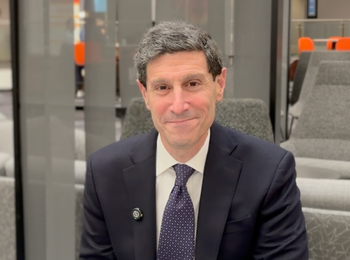
Dr. David Battinelli, dean of the Zucker School of Medicine and Northwell Health’s physician-in-chief, talks about rethinking medical education, engaging students, and AI.
For too long, medical education has been anchored by lectures from the “sage on the stage,” Dr. David Battinelli says.
Battinelli, dean of the Donald and Barbara Zucker School of Medicine at Hofstra/Northwell and physician-in-chief of Northwell Health, relishes the chance to lead a medical school that trains doctors differently.
The medical school, founded in 2008, focuses on collaboration with students and simulations. Tests involve essays and oral questions, and there are no multiple-choice questions. Students begin clinical training right away.
Battinelli and Dr. Lawrence G. Smith, the medical school’s founding dean, recently co-authored a book, “Revolutionizing Medical Education: Proven Blueprint to Transform Curricula and Prepare Future-Ready Physicians.” In an interview with Chief Healthcare Executive®, Battinelli says that too much of medical education has been unchanged for decades.
“We needed to train people clinically from the very first days of medical school,” Battinelli says. “And so what we did was we put people into the clinical disciplines, including EMT training and everything, right from the very first day. Every doctor over the last 50 years who's ever gone to school has said the first two years of medical school wasn't really medical school. We made it medical school.”
Students don’t learn from listening to lectures, and he says medical school lectures have been poorly attended for years, with many students skipping the lecture and getting the notes afterward.
“We all knew that no medical school in the country really had better than a 30% attendance in lectures,” Battinelli says.
Read more:
‘Learn how to learn’
While Battinelli proudly shares the medical school’s approach, he’s careful to point out that many of the ideas come from others.
When the Zucker medical school was being built, Battinelli says the school solicited ideas from academic leaders. He says others implored the school to take a novel approach.
“We said to all the best medical educators, ‘If you could start from scratch, what would you do?’ And they said, ‘Please, here's our idea. We can't do it. We're not allowed to do it. You do it.’ And so, we pieced them all together in a Technicolor garment, right, and that's what it looks like,” he says.
Battinelli credits Hofstra University and Northwell with empowering the school to chart a new path.
“The secret sauce was being able to have the latitude and freedom,” he says. “So we had phenomenal support from Hofstra University, from Northwell Health. They believed in our ideas, and we set up governance that would allow us to do those things that other places didn't have.”
Battinelli says the school eschewed lectures in favor of case-based learning in small groups.
Students are assessed on knowledge and action, through oral exams, essays and simulations. Battinelli says multiple-choice questions don’t accurately reflect a student’s understanding.
“The idea was, if you can't explain it to a patient, then … I don't really care if you get it right on a multiple choice question test,” he says.
Critically, the school doesn’t focus on students memorizing volumes of facts.
Rather, Battinelli says, “We have them learn how to learn.”
Battinelli says the school’s approach met with early skeptics.
“We were challenged by everybody who said you were dummying down the science,” he says. “You can't put students in front of patients before they know all the science. Nobody will pass their boards. People won't hire them. And again, without lauding ourselves, every single one of those metrics was blown out of the water.”
“The crazy part is these were not our ideas,” he says.
The ‘anti-brainwash’ school
The medical school gets several thousand applicants for 100 available spots.
Battinelli says Zucker aims to be “the anti-brainwash med school.”
“We don't have a prescription as to what we're trying to create,” he says. “We want people to be in love with the discipline they choose, and so our students go into all of the various disciplines. It's much more important for us that they love what they do and they want to keep doing it for the rest of their life.”
Medical students face a rigorous path to become physicians, and Battinelli says it’s not an easy profession.
But he says the school also focuses on the health of its students.
“Our job is to make sure that everybody understands that they are going to be asked to deliver excellent patient care, learn every day, and most importantly, figure out how to enjoy and have fun,” Battinelli says.
“If you can't figure out how to work hard and have a healthy life, then you will struggle. So we help with that a lot,” he says.
And he says students aren’t burning out in the school.
“The best feedback we get is from the parents of medical students who are doctors, and look at us and say, ‘My son, my daughter, my kid has never been happier. I don't know what you're doing because when I was in med school, that wasn't what was going on,’” Battinelli says.
Looking to the future
With AI playing a bigger part in healthcare, Battinelli says medical students are entering a rapidly changing environment. Even as new physicians eventually begin using AI, he says they will need critical thinking skills.
When asked about preparing medical students in using AI, Battinelli says, “That's going to be a challenge, and I don't have the answer to it yet, other than I welcome the challenge and I'm not going to fight it.”
But he says he expects AI is going to be “phenomenal” in addressing a number of intractable problems.
Battinelli points to improving the continuum of care for patients, and the difficulty too many patients have in getting access to care. He sees the potential of AI in helping improve a fragmented system.
He’s hopeful that AI can help level the playing field and improve equity in care, even as he acknowledges concerns of
“Healthcare disparities are the biggest evil we have in the healthcare system,” he says. “People don't get the same treatment.”
Battinelli doesn’t see AI replacing the role of physicians.
“I have AI supplementing the care model,” he says. “There will be doctors. There will be nurses, and there'll be some robots doing things that other people did before.”
With AI and other changes, Battinelli says medical school leaders need to be looking ahead and trying to anticipate the skills future doctors are going to need.
“If you're not thinking about what the skill set is of the person in 2040, you're not doing that person a service,” he says. “So you've always got to be looking many more years into the future.”
“If you've got a model that you've been doing for the last 20, 30 years, just because you turned out perfect, it's not the perfect model for the future.”