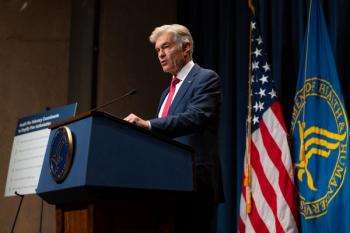

Dr. Myechia Minter-Jordan came to the conference to push for technology aimed at helping seniors live better.
AMA data show where insurers hold sway, and the analysis suggests consolidation is increasingly happening across health care sectors.
For hospital and health system leaders, payer negotiations rank among the most consequential conversations of the year. New data suggest the companies on the other side of the table remain as dominant as ever in most of the country.
In 2025, 95% of U.S. metropolitan commercial health insurance markets were highly concentrated, and in 47% of metro areas, one insurer held at least half the market, according to a
“Health insurance markets across the country remain stubbornly concentrated, limiting competition and putting consumers at risk of higher costs and fewer choices,” AMA President Willie Underwood III, M.D., M.Sc., M.P.H., said in a news release.
The study drew on 2025 enrollment data from Decision Resources Group covering 385 metropolitan areas, all 50 states and the District of Columbia. AMA economists José R. Guardado, Ph.D., and Carol K. Kane, Ph.D., measured concentration with the Herfindahl-Hirschman Index (HHI), the yardstick the U.S. Department of Justice (DOJ) and Federal Trade Commission (FTC) use in reviewing mergers. Under the agencies’ 2023 merger guidelines, a market with an HHI above 1,800 is highly concentrated.
The AMA, which represents physicians, has published the study for 25 years. The same research division also tracks competition in
The share of highly concentrated commercial markets has stayed between 95% and 97% every year since 2014. The average HHI rose 87 points over that period. Falling concentration in the Affordable Care Act exchanges masked larger increases elsewhere, the authors said; excluding the exchanges, average concentration rose in nine of the past 11 years, by a total of 401 points.
Blue Cross Blue Shield (BCBS) insurers remain the dominant commercial force. Counted together, they held 42% of the national commercial market and had the largest share in 43 states and 84% of metro areas. Among individual companies, UnitedHealth Group led nationally with 15%, followed by CVS Health’s Aetna and Elevance Health at 12% each.
The Blues are also consolidating across state lines. The report noted that BCBS of Michigan acquired BCBS of Vermont, Highmark acquired BCBS insurers in New York, Arkansas BCBS and BCBS of North Dakota are merging with Cambia, and BCBS of Kansas City is merging with Highmark. The result, the authors wrote, will be fewer independent and more and bigger multistate BCBS insurers.
Medicare Advantage (MA) showed a notable shift. Average MA concentration fell every year from 2017 through 2024 but rose in 2025 by 28 points, the first increase in the study period. In the most recent report, 97% of metro MA markets were highly concentrated, compared with 99% in 2017.
UnitedHealth Group held 30% of the national MA market, up from 25% in 2017. Humana followed at 17% and CVS (Aetna) at 12%. Cigna has since sold its Medicare business to Health Care Service Corp. and exited MA.
The study has long informed antitrust reviews. When Anthem sought to acquire Cigna and Aetna sought to acquire Humana in 2015, AMA researchers used earlier editions to identify markets where competition would suffer. The U.S. Department of Justice and several state attorneys general sued to block both deals, which were abandoned.
Those outcomes appear to have chilled horizontal mergers among insurers, the authors said. Instead, insurers have turned to vertical deals, such as the Aetna-CVS merger, which tend to receive more antitrust leniency. The largest insurers are now also the largest pharmacy benefit managers and prescription drug plan sponsors, and some own care delivery assets.
The report cited UnitedHealth Group, which employs almost 10,000 physicians and contracts or affiliates with about 80,000 more, as the prime example. It also cited Kaiser Permanente, which is large in its hospital markets and employs more than 25,000 physicians.
“A small number of massive health care conglomerate platforms exhibit many of the same concerning characteristics as big tech platforms,” the authors wrote, adding that similar antitrust scrutiny may be necessary.
The American Hospital Association (AHA) has used the AMA’s earlier data in its own case against insurer practices. In a
Hospitals spent $43 billion in 2025 seeking payment from insurers for care already provided, according to the AHA’s annual “Costs of Caring” report, as Chief Healthcare Executive
Market power on both sides shapes how those negotiations play out. A peer-reviewed
Both sides used the tactic. Profitable hospitals, for-profit hospitals and hospitals commanding relatively high prices were the most likely to make public threats, while national insurers were more likely to do so than single-state or regional insurers. Public threats occurred in about 16% of relationships where the hospital system controlled roughly 25% to 45% of local beds and the insurer covered roughly 30% to 45% of local commercial lives. The authors said the findings show the importance of local market conditions in shaping hospital-insurer relationships.
The pressure can be acute for rural facilities. Payer consolidation has left many rural hospitals negotiating with insurers that dominate their local or regional markets, as a recent Chief Healthcare Executive
The AMA said any further insurer mergers would come at a time when competition is already limited in most markets. It called for continued antitrust scrutiny of insurer consolidation, including vertical and cross-market deals. Cross-market deals can escape review because the merging companies don’t overlap locally, yet they still expand an insurer’s overall footprint, as Centene’s acquisition of WellCare did in MA.
AHIP, the health insurance industry’s trade group, has disputed past editions of the study, saying in a
“Strengthening competition is essential to protecting consumers and making health care more affordable,” Underwood said.