Several groups say that AI is a valuable tool, but warn physician expertise is essential. They push back against efforts to pit doctors against technology.

He says hoping conditions improve isn’t a viable strategy. He also says it’s time to recognize that the government and employers expect more from health systems.
Las Vegas – David Banks turned to one of his passions to describe the current moment for hospitals and health systems.
Banks,
“Nothing strikes fear in the heart of a cyclist like a headwind,” Banks said.
“Your heart rate goes up. You start to sweat a little more, and you start to think: ‘I don't know how long I can actually do this,” he said.
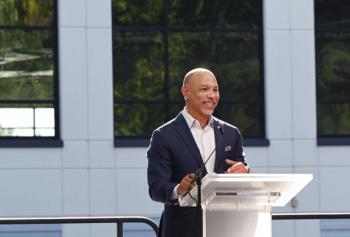
Speaking at the first day of the HIMSS Global Health Conference & Exhibition, Banks says it’s important to recognize the headwinds and respond accordingly. He says it’s not a viable strategy – in cycling or health care – to simply hope for the winds to subside.
“Hoping the headwind goes away, likely moves to complete disruption,” Banks said, adding, “There's actually not much hope, as you know, for those who choose complacency, ignoring trends.”
Banks said it’s possible to find a winning position even with the headwinds, and he also says the environment may be more favorable than some realize.
“I think we're in the upcycle of the healthcare market right now,” Banks said.
“The technology has never been better, stronger, more capable,” he said. “Never has more been spent. You talk to employers, you talk to state governments, you talk to federal governments, they are spending immense amounts of resources to where we're one of the biggest sectors for the economy. You want to be a part of the economy that people are spending money into.”
Healthcare leaders also must recognize that there’s dissatisfaction in what health systems are delivering, he said.
Banks pointed to a recent meeting with Dr. Mehmet Oz, administrator of the Centers for Medicare & Medicaid Services. Banks said Oz was puzzled why advances in technology aren’t leading to more productivity gains.
“That benefit of having everyone spending their money with us actually comes with some expectation, and they don't think we're meeting that expectation,” Banks said. “Employers and governments don't like the value they're getting from us.”
Banks said it’s important for healthcare leaders to expect the headwinds.
“I'm not saying …be a pessimist, assume that the sky is falling. But headwinds are inevitable. The goal is not to avoid the headwind,” he said.
“It's simply to not let it be a total disruption to what your purpose called you to do,” Banks said.
Banks also cited a tactic in cycling, when a group of cyclists will ride in a single file during headwinds, helping others in the line of cyclists to move faster with less effort.
“There is momentum in the pack,” Banks said. “Everyone is cruising along at rates and speeds they could not do by themselves.”
But eventually, cyclists in a race will move away from the single line, and they will start looking to get in a better position for victory.
“Those who can get into the right configuration realize surviving the headwind is not the end goal,” Banks said. “The goal is to get through it so that you can get on with your work to get to the finish line. Getting positioned, or accurately, more repositioned, is really the goal.”
Banks said it’s critical for healthcare executives to take a similar approach in facing the challenges ahead.
“It's very difficult to ignore what's happening,” Banks said. “The complexity is enormous. We are indeed facing some challenging times ahead.”
Banks stressed the importance of clarity of purpose. He pointed to the example of former AdventHealth CEO
During the first six weeks of the pandemic, Shaw led AdventHealth’s pandemic command center. But then he stepped away from that to focus more on what the health system would look like after the pandemic.
“He understood that headwinds we were in the middle of, and understood … surviving this is not our sole goal. Our goal is to be the strongest version of our organization, we could be coming out,” Banks said.
Banks encouraged leaders in the audience to think about what aligns them to their purpose, and to take one step toward getting into better position.
“That is how resilience is built, in my opinion,” Banks said. “And that is how we will best serve those who desperately rely on us for the healthcare services that they need.”