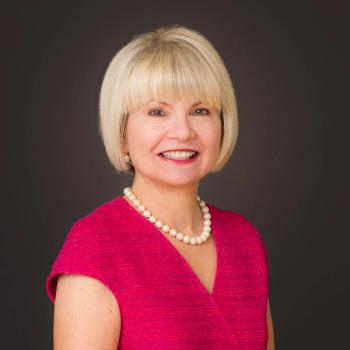
Maria Ghazal, president and CEO, talks about finding consensus across the healthcare ecosystem and in Washington.
In a wide-ranging conversation, she talks about caring for an aging population, changing federal policies, and why hospitals are facing a different kind of pivot point.
Hospitals in Florida are facing growing pressures and at a time when demand is surging, Mary Mayhew says.
Mayhew is the president and CEO of the Florida Hospital Association. She spoke about the challenges facing Florida’s hospitals - and hospitals across the country - in the latest episode of
In a wide-ranging interview, she talked about federal policy decisions that are impacting hospitals, including
She brings a wealth of experience and perspective on the changes in the industry. In addition to leading the Florida Hospital Association for nearly six years, Mayhew formerly served as deputy administrator and director of the federal Medicaid & CHIP Programs, and she spent several years as Maine’s Commissioner of the Department of Health & Human Services.
Here are some excerpts from our conversation.
Q: Things are always changing in healthcare, but has the pace of change been even faster over the past year or so?
A: “It feels like it's operating at warped speed. I've been doing this for a long time. A lot of these issues are cyclical when we think about financial stressors, payer mix, workforce, physician recruitment.
“But there's something different now, Ron, in terms of the demand on healthcare, and maybe Florida, to a certain extent, because of the population growth and the rapidly aging baby boomer generation. We're at a different pivot point, if you will, that frankly demands greater change in order to respond to the ever persistent challenges in healthcare, but more importantly to anticipate and to respond to this skyrocketing demand.”
Q: Let's talk about that aging population, because that's something that's on the mind of a lot more hospital leaders. You've got the last Baby Boomers hitting retirement age by the end of the decade, and Florida is a magnet for people that want to go to the Sunshine State to retire. So, is this something that hospitals are really having to think about in terms of caring for a population that is aging and is going to need more healthcare services likely in the coming years?
A: “Absolutely, front and center. Generally, when you think about hospitals and the patients that we're caring for, it obviously skews to an older population. But when we look at our numbers in Florida, today we have over 4.5 million individuals over the age of 65. By 2030, that number will exceed 6 million.
“We have hospitals today that are already operating at 95% occupancy, 100% occupancy. That's not what you want. That's not an ideal occupancy rate. It does not allow for the unexpected, the flexibility that you need.
“Another significant factor is not just how the hospital and health system responds, Ron, but the full continuum, and that I think is an area that I'm extremely concerned about. Do we have the capacity in skilled nursing facility beds, in rehabilitation beds, in home-based care, and home health, all of those? And assisted living has to be part of the equation.
“Otherwise, the pressure just builds back up into the hospitals that are already maxed. It's incredibly expensive to build new hospitals, it's incredibly expensive to add new beds. So how do we both recognize legitimate increased demand on acute care hospital level of services, but also evaluate the rest of the continuum and its ability to respond to the demand, but also the modern sophisticated approach to delivering those services.”
Q: We also have some other changes hospitals are going to have to deal with in the passage of HR 1 last year, the tax package that
A: “When we talk about responding to demand, it means having the resources to adequately invest, not just in the physical plant capacity, but in the workforce, recruiting the physicians, investing in the latest standard of care, in terms of technology that needs to be readily available, so having those resources, having the financial stability, and not just a break even margin, or a 2% or 3% margin. You've got to have a margin that can sustain those investments.”
“What was not included in HR 1, was an extension of the enhanced premium tax credits …. for Florida, we lead the country in the number of individuals who are getting their individual health insurance coverage through the marketplace, so as a result we will see some of the largest impact in the number of individuals who will now be uninsured because those enhanced premium tax credits were not extended.
“We quickly surveyed our membership to try to get a snapshot of the impact. Of those that responded, we saw, for inpatient admissions, over a 20% increase in uninsured between the 1st quarter of 2025 and first quarter of 2026. And that's before the grace period has actually completely run out on individuals making their payments for insurance coverage in the marketplace.
“So, incredibly concerned, we could see between 750,000 and a million Floridians lose coverage because of that dependency on those enhanced premium tax credits. So we're going in the wrong direction in terms of right care, right time, right setting for the patients.”
Reminder: We have an audio version of Changes made for listening on the go. Get it wherever you get your podcasts.
Check out other recent conversations: