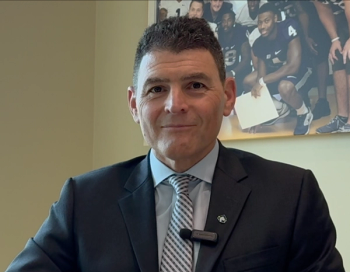
Dr. Michael Kupferman talks about the $50 million gift from the Golisano Foundation and joining an alliance of children’s hospitals.
Dr. Michael Kupferman says the contribution from the Golisano Foundation will expand care and help train more doctors in pediatrics.
Penn State Health has provided a wide variety of care for children for decades, but
“It's exceptional clinical care that only we provide here in the region, the subspecialty care that we provide for some of the most fragile children, our goals around training the workforce of the future in pediatric specialties, and then lastly, bringing medical innovation to this region,” Kupferman says.
In a conversation at the Penn State Health corporate campus for the latest episode of Changes, a video series from Chief Healthcare Executive, Kupferman outlined how the health system will be using the gift.
The Golisano Foundation has worked to create a network of children’s hospitals working together to establish best practices in pediatric care. Tom Golisano, the founder of Paychex, Inc., has contributed $578 million through his foundation to pediatric hospitals across the country. The foundation announced that Penn State Health was one of the recipients last fall.
For Penn State Health, the $50 million gift will be used to expand care in a number of different ways. Kupferman points to plans to bolster cardiovascular care, which he already cites as a strength.
“We have an exceptional congenital heart program here, where children from around the region who suffer from disorders of the heart come to us for complex surgical care, complex medical care,” Kupferman says.
Penn State Health is also expanding support for behavioral health. The system has recently opened a new behavioral health area at Penn State Health’s Holy Spirit Medical Center for kids and teens who need inpatient admission.
The system is also opening a neonatal intensive care unit at Penn State Health’s Lancaster Medical Center, one of the system’s newest hospitals.
“That's going to serve the community of Lancaster and the surrounding area in Lancaster County for some of the sickest children,” Kupferman says. “So these funds are really transformational for us.”
The health system has also acquired a new incubator for neonates to be transported by helicopter.
“We are the hub for pediatric care in Central Pennsylvania, and that means that we have children coming to us from remote parts of the state,” Kupferman says. “They can't always get here by ambulance. Sometimes, because of the urgency of their needs, they have to arrive here by helicopter. And so we've recently acquired a new isolette for neonates to be transported by helicopter here as part of our Life Lion fleet.”
In addition to broadening opportunities for patient care, Kupferman says he’s particularly enthusiastic about utilizing the funds from the Golisano Foundation to train more doctors to work in pediatrics.
“We need to do our part to continue to sustain the amazing care that we provide here. And that means planning for the future, and that entails training and educating fantastic medical students who are coming from our state to train right here to become physicians,” Kupferman says.
“And then at the same time we want to continue to provide great graduate medical education opportunities right here at Penn State Health, training pediatricians, training pediatric subspecialists, training pediatric surgeons,” he adds. “And so we continue to invest in our graduate medical education programs and provide an amazing experience for our trainees, for our learners, so that when they graduate, they want to stay right here. They want to make this their home. They want this to be their professional home.”
Part of that approach means reducing the cost of medical education, he says.
“We're supporting loan forgiveness programs for pediatric residents who are graduating from the residencies, who are going to stay here in Central Pennsylvania, join the Penn State Health team,” Kupferman says.
“The cost of medical education today is very high, and many medical students are graduating with many hundreds of thousands of dollars of medical debt,” he says. “And so we view one part of our mission is to help reduce the debt that medical students are undertaking by providing debt relief for medical students, for our pediatric trainees with the Golisano Foundation funds.”
Penn State Health is poised to expand its research capabilities with the Golisano Foundation gift. Kupferman says the system is boosting investments in a number of key areas of its pediatric research program.
“We are bringing medical innovation to patients so that they don't have to travel outside of the region, so they can have all of their support from their families, from their friends, right here in Central Pennsylvania, and not have to travel elsewhere for, say, a clinical trial,” Kupferman says.
Working in partnership with the Penn State University College of Medicine, the system is developing a pediatric torso assist device to help children with pulmonary difficulties in the first few days after birth.
Penn State Health is also working to develop a heart pump for babies and children.
“There are many that have been developed for the adult population, but none for the pediatric population,” Kupferman says. “We're creating one right here in central Pennsylvania at Penn State College of Medicine in partnership with Penn State Health.”
“We're also committed to investing and supporting and growing clinical trial opportunities for tomorrow's therapies, bringing them right here today for areas such as lung disease, kidney disease, behavioral health and psychiatric disorders, as well as autoimmune disorders, all focusing on children. And so we're advancing our mission to advance medical innovation and helping to support the future of pediatric care,” he says.
The foundation’s funds will also help attract more top scientists to Penn State Health, Kupferman says.
“We're excited about continuing to recruit fantastic, talented pediatric researchers,” he says. “And some of our funds that we have received from the Golisano Foundation are going to be utilized for recruitment of individuals who are leading pediatric researchers, leading pediatric clinicians, and help support the great work that they do and the great work that they're going to continue to do here at Penn State Health.”
With such a contribution, Kupferman acknowledges there is pressure to meet expectations.
He says there are several measures Penn State Health is using to determine if the system is having an impact.
“It's the number of children that we are able to see in our clinics, it's around the number of children whose lives are touched by some of these newer therapies,” he says.
Kupferman points to examining how many therapies move from the investigational stage into clinical practice, the number of pediatric residents in the system, and the impact Penn State Health is having on its communities.
“We are a system that takes stewardship of philanthropic dollars very seriously,” he says. “And I think that's one of the reasons why we look forward to those successes, because we're successfully able to translate donor intent into real impact, and that will be no different with the resources from Mr. Tom Golisano.”